TRICARE service centers to close soon

During my transition from active duty to the civilian world I found myself in the position of deciding just how I would procure health insurance for my family and I.  As a uniform wearing Marine my healthcare was covered by the local aid station, clinic, or hospital, but once I hung it all up that option vanished when my ID card switched from “Active” to “Retired”.

I have never had to make such a decision before; after all, medical care was part of the benefits package for those in uniform.  Fortunately, at my local Naval Hospital there was a TRICARE service center.  In the TRICARE service center was a real live human being who was both cheerful and helpful, and after spending a half hour or so with her I was able to make the right decisions and sign up for TRICARE Prime so that both my family and I would be covered once my HMMWV chariot turned into a pumpkin.

Unfortunately, that service center and the 188 others that are spread across the continental United States will be closing next year.  They will be replaced by a call center.  Although TRICARE states that customers will receive better service by calling a 1-800 number I somehow doubt it.  There is nothing like sitting down with a real person to get your questions fully answered.

Sadly the cheerful and helpful lady who helped me out will likely be out of a job next year.  Although TRICARE administrators project a $250 million savings by cutting the centers, the cost in terms of jobs and true customer satisfaction are going to be high.

At least in my humble opinion.

It’s here! Orders to Nowhere is now a book!

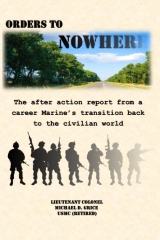
It’s finally here!  The first edition of Orders to Nowhere is available in print.  It will be six to eight weeks before it shows up in bookstores, and a week or so before it hits Amazon.com.  If you want to avoid the wait, you can order it straight from the printer by clicking the cover:

Orders to Nowhere

Since you are a loyal reader and follower of the blog that got it all started, you can use the discount code ZVGYFQ28 and save 10% off the cover price.

Thank each and every one of you for reading and following my journey through transition!

Happy Veterans Day!

To everyone who serves or who has ever worn the cloth of the nation:  Happy Veterans Day!

Remember the sacrifices borne by those who have gone before us.  Never forget.

A tragic but true story of a Marine in trouble

This morning a friend emailed me a link to a particularly disturbing story.  It is a very well written blog post  in the New York Times that provides an unusually unvarnished look into the dark pit that is PTSD.

There are plenty of articles and blog posts about PTSD bouncing around the internet, but this one is compelling in a way that so many others are not.  In this post the author candidly and openly describes how he attempted to end his own life because the lingering effects of his wartime experiences on his psyche.  He takes the reader with him as he writes the note that his wife will find with his cold and lifeless body and as he swallows an entire bottle of pills.

I won’t give the whole article away because it is too well written and too insightful for my humble efforts to recount it.  You can read it here.  I will say that it is an articulate indictment of how this Marine was treated by his supposed leaders when he reached out for help; if his treatment is indicative of how others are treated when they try to overcome PTSD while still in uniform then a lot of so called “leaders” need to look long and hard in the mirror.

They are not leaders.  They are anything but, and are a wretched example of what some implacable and soulless men and women in positions of responsibility can do to those that they have been entrusted to lead.

Sad.

What’s next for military pay and benefits?

My last post was about the impending — and expected — drawdown of the military.  The United States is following the path of many other western nations as they shed soldiers and sailors in an effort to curtail the expense of national treasure and return their armed forces to the size they deem more appropriate for a post-war world.

It does make sense.  After all, standing armies, navies, and air forces are extremely expensive and tough to justify in times of peace (or at least of times of non-war, which seems to be a more apropos description of the 21st century age in which we live).  It has all happened before, and it will surely happen again.

For those who remain in uniform, however, things may well be changing as well.  The Department of Defense is considering pretty much any idea or option that comes to the table in terms of reigning in the costs of personnel, consume about a quarter of the DOD budget.  Various studies and commissions have examined the issue of military and military retiree compensation, and with the austerity brought on by the economy and sequestration such benefits come under greater scrutiny.

One of the latest efforts is the Military Compensation and Retirement Modernization Commission, a congressionally mandated effort to determine the “long term viability” of  military compensation (for more information, read today’s Stars and Stripes coverage of the commission here).  All things considered, looking under the hood of the military compensation machine is not in and of itself a bad thing.  It happens after every war, but this time the scalpels are sharp and the desire to perform some cost cutting surgery is possibly stronger than ever.

Efforts to change pension benefits, pay structures for serving personnel, medical coverage for retirees, and countless other benefits have been in the news lately and the new congressional panel is yet another bureaucratic mechanic crowded under the hood of the machine trying to dismantle what they can.

As I wrote earlier, a reasonable review is perfectly appropriate as the wars draw to a close.  The moral imperative of meeting the obligations of the nation to those who serve it, however, should be paramount in any discussion about tinkering with or cutting compensation.

I sincerely hope that the commission keeps that in mind.

Here it comes: the big drawdown

It seems that every day brings news about the future of the military, and today was certainly no exception.  The Army, according to a Thomas Ricks’ post in Foreign Policy, is about to start separating officers from the service.  (Click here to read it)

There has been a lot of howling about how sequestration is causing the downfall of the military, and that the danger of a hollow force is only a manpower cuts away, but in all practical reality the end of the wars in Iraq and Afghanistan make a smaller military inevitable.  It happens after every major conflict; the US Army numbered under 400,000 active and national guard troops in 1939, but by the end of the Second World War it had swollen to over 8,000,000. At the start of the Korean War some five years later the army was down to 630,000.

One of the principal reasons that the drawdown in the near future is different from those from prior wars is the composition of the force.  There are no draftees in today’s military.  Each and every Soldier, Sailor, Airman, and Marine volunteered to serve his or her country, and as a result more of them are likely to want to stay in the military than their predecessors.  At the end of the First and Second World Wars the armed forces (which were filled with draftees and wartime volunteers) shrunk naturally as people headed back to the lives they interrupted to go to war.  The same can be said for Korea and Vietnam to certain extent, as draftees were critical to expanding the armed forces to the size needed to fight those wars.

Today, though, we have no draftees.  Instead, we have a highly trained force of military professionals who have dedicated themselves to a career in the military.  Sure, the majority of first term enlistees serve one hitch and get out, but a significantly larger percentage want to stay.

Therein lies the rub.  As the military inevitably shrinks, the number of job slots that military folks can fill will decrease.  For the enlisted component of the armed forces, the length and terms of the enlistment contract can be used to decrease the size of the force; the military branches can make it more restrictive and difficult to reenlist. It is an effective manpower shaping tool.

For officers, however, the rules are very different.  Generally speaking, junior officers (ensigns and lieutenants) serve an initial contracted period (during which they are considered “reserve” officers), which is very similar to the enlisted side.  If they want to stay in, however, instead of reenlisting they compete for transition to from “reserve” to “regular” status.  Once an officer becomes a regular, his contract disappears and his term of service becomes “indefinite”.  This means that they are in until they 1) retire 2) quit 3) fail to get promoted or 4) die.  There is no enlistment contract to use as a force shaping tool.

During stable periods this is no big deal.  The services have staffing models that pretty accurately predict the size that the force needs to be, and they can manage the number of officers based on the number they are allowed to have by law, natural attrition, and accession of new officers.  During unstable times, though, like right now as we finish up a couple of wars, the models come apart like a trailer in a tornado.

The military had to significantly change its shape and size to fight the protracted counterinsurgent wars.  Many more boots on the ground were needed, which means that privates and second lieutenants were getting hired at the rapid rate (meaning much were donning the uniform than usual), and as time went on they got promoted to become sergeants and captains.  Enough time, in fact, that many of the officers became regulars.

Now that becomes a problem.

The enlisted side can be shaped using enlistment contracts, but the regular officers are immune from that shaping tool.  Instead, to reduce the number of officers (which is necessary to retain the proper shape of the force) the branches must figure out a way to get them to leave.  There are a lot of programs that are used to entice officers to leave (early retirement, “getting out” bonuses, etc), but when those do not get enough officers to leave the axe comes out.

In the Marine Corps the axe is the Selected Early Retirement Board (SERB).  Colonels and Lieutenant Colonels who fit a particular set of conditions are considered for retention or retirement.  Even though they can, by law, serve until their service limitations of 30 and 28 years respectively, the Marine Corps does not need them around for that long.  If they are selected for early retirement by the SERB, then they have about seven months to transition out to retirement.  The reason that such senior officers are targeted in the Marine Corps is that by lopping off people at the top it frees those below them to move up.

The Army is apparently about to do the same thing, except for a much junior set of folks: captains and majors. From Ricks’ blog post (a portion of letter sent from a senior officer to his or her juniors):

“You may already know, but there are going to be Officer Separation Boards (OSB) and Enhanced Selective Early Retirement Boards (E-SERBs) for Army Competitive Category Captains in Year Groups 2006-2008 and Majors in Year Groups 1999-2003 beginning in March 2014.

Initial word is that the OSBs and E-SERBs will select less than 10% of the considered majors and captains in year group 2008 and less than 20% of the captains considered in year groups 2006 and 2007.

I am meeting with the officers in the battalion affected that are physically at Ft. [DELETED] to discuss their Professional Development and future officer actions and will provide them an assessment of their potential for future service and potential risk of being selected for involuntary separation, and will help prepare their files for the boards. Additionally they are contacting their HRC Branch Representatives for an assessment. I recommend you find a trusted senior officer to do the same.”

The writing is on the wall.  Despite the promise of an exciting career in uniform, many officers are going to get the axe.  Is it good?  Is it bad?  I dunno.  In the mafia, they say that “it’s just business”.  The military needs to shrink, and it is not sequestration’s fault.  How the shrinking is done, however, says a lot about the moral contract between the institution of the military and those who serve within it.

Food for thought.

Orders to Nowhere: The Book!

Coming soon!  The launch date is expected by be no later than November 10th, but hopefully sooner. I’ll post a note as soon as it goes live.

Written over the two years of navigating the often frustrating and always confusing waters of military transition, Orders to Nowhere is finally available in print!

Orders to Nowhere is the essential insider’s guide to military transition.  Demystifying the uncertainty and ambiguity that surrounds getting out of the military, Orders to Nowhere is the comprehensive After Action Report of a career Marine’s transition from the tightly knit military world back to civilianhood.

Tens of thousands of Soldiers, Sailors, Airmen, Marines, and Coast Guardsmen transition back into the civilian world each and every year. The change from life in uniform to life beyond the military is a significant emotional event for everyone who experiences it. Hanging up your uniform for the last time isn’t easy, and Orders to Nowhere was written to help explain the overwhelming process and make it easier for military members planning to get out, while they are in the midst of transition, or after they become veterans.

Mike Grice is an award winning writer, retired career Marine, and intrepid explorer of the military transition process.  Orders to Nowhere is the journal of his experiences , but it is also the story of every Soldier, Sailor, Airman, Marine, and Coast Guardsman who takes off the cloth of the nation and goes back to civilian life.  Written during the author’s adventure through the trials and tribulations of transition, Orders to Nowhere eases the pain by giving an inside look at the widely varied aspects of military to civilian transformation.  Things like:

 -making the decision to hang up the uniform
– telling your boss that you are getting out
– the administration and logistics of moving on
– the emotional roller coaster of transition 
– effects on family
– transition decorum and ceremonies 
– the details of military retirement benefits
– transition assistance classes
– dealing with the Veterans Administration
– VA disability claims
– the Post 9/11 GI Bill
– finding a job
– how to dress like a professional
– writing a resume and cover letter
– networking
– interviewing for a job
– salary and benefits negotiation 
– adjusting to civilian life
– and much, much more

The book contains over 160 lessons learned and recommendations that can help anyone going through the military to civilian transition avoid making costly mistakes.  The path back to “normal” life is anything but normal, and Orders to Nowhere is the traveler’s guide that every member of the military and veteran needs to ease the pain of the journey.

A must for every man and woman in uniform to help make transition as smooth as possible!

Jobs for veterans: companies that are really stepping up

One of the most distressing parts of making the jump from wearing the cloth of the nation back to the civilian world is finding a new way to make a living.  Nobody in the military does it for the money (well, nobody I ever met) but money keeps all of us from living in a refrigerator box under an overpass and begging for spare change.  Transition is stressful, and with a down economy and the news filled with negative reports about high unemployment and low wages many veterans see unemployment and even poverty as real possibilities once they get out.

Fortunately, there are some really great companies in this nation of ours who have stepped up and pledged to bring veterans on to their rolls.  Whether it is from a sense of civic duty, recognition that military folks have skills that employers really want, or simply for the positive press that it generates doesn’t matter.  What matters is that firm after firm is opening their doors to veterans.

Good on them, I say.  And thank you!

Many of these companies have been in the news lately.  I won’t attempt to rewrite the stories that are already bouncing around the net, but here are links to a few that I found to be compelling about companies that are reaching out to veterans:

10 COMPANIES THAT ARE ‘HEAVY HITTERS’ IN HIRING RETURNING SOLDIERS

Wal-Mart Plans to Hire Any Veteran Who Wants a Job

Michelle Obama to Keynote Disney Event on Hiring of Military Veterans

Again, a huge thank you to those businesses that recognize the value of our veterans.  Countless veterans can breathe a little easier and avoid thinking about refrigerator boxes thanks to the prospect of a job on the other side of transition.

Warrior Wives Conference

Yesterday I had the pleasure and privilege of meeting around 50 women who share the distinction of being married to servicemen who have been, currently are, or will be deployed into one of the many hot spots around the world. I met them at the Warrior Wives Conference. which was hosted by Veterans 360 (a great non-profit organization that helps servicepeople and veterans who are dealing with the challenges that every military family faces).

The conference brought together people who were concerned with the changes that their warrior husbands exhibited after their return from combat.  It was a tremendous venue, with knowledgeable guest speakers, booths manned by over a half-dozen public and non-profic support organizations, a panel discussion, and refreshments. The morning could not have been better spent.

Having the opportunity to speak with such dedicated women was tremendous.  There is a lot of press out there that addresses the effects of PTSD and combat stress on those who suffer from it, but there is not nearly as much about its effect on families.  Every combat veteran struggles to reconcile their experiences in the fight with the realities of home, but those with spouses and children often have the added stress of trying to fit the mold of who they used to be in order to make things at home “normal” again.  Too often they find it impossible to go back to who they were before they went to war, and as a result they begin to resent who they have become.  It often becomes a vicious downward cycle that ends in alienation, acrimony, separation, and divorce.

Wives shared their frustrations with how their husbands were treated by their senior leaders and the mental health care system.  Several voiced disgust about seniors who refused to let their spouse seek care without retribution, and others shared how they were disrespectfully treated when they tried to become active in their spouse’s treatment; two of the participating wives were told that they were the problem.  I find it amazing that those who are battling to keep their families together must fight the very institution that officially promises to help them overcome the devastating challenges of combat stress and family reintegration.

It was a cathartic day.  Spouses who felt isolated and believed that they were alone in their pain found others who were rowing in the same boat.  A lot of tears were shed and new friendships were made. Every person who attended the conference left with a new group of friends and a greater set of resources that would help them with daily struggle to overcome the effects of combat stress, and I believe that each departed a little more hopeful for the future of their family.

Our wars are coming to an end.  Iraq is behind us and Afghanistan soon will be.  The effects of those wars on the families of those who fought them won’t end so readily, however.  In the last paragraph of his second inaugural address, the great president Abraham Lincoln made a promise to veterans and their families at the height of the Civil War:

“With malice toward none, with charity for all, with firmness in the right as God gives us to see the right, let us strive on to finish the work we are in, to bind up the nation’s wounds, to care for him who shall have borne the battle and for his widow, and his orphan, to do all which may achieve and cherish a just and lasting peace among ourselves and with all nations.”

Noble words then and as true today as they were the day he spoke them.  The nation owes a debt to all who suffer because of the wars it fights, and not to pay that debt is a breach of faith and dereliction of duty beyond measure. The inaugural Warrior Wives Conference initiated a grassroots dialog about how things are really going in the homes touched by combat stress.  I hope that the conversation grows.

Stepping up

Yesterday the government managed to pull itself out of the partisan swamp long enough to pass legislation to reopen the government for business and raise the debt ceiling.

What if they hadn’t?

Many veterans rely on the checks that they receive from the government just to survive.  One of the most at-risk groups consists of those who were wounded in the service of the nation and as a result are often limited in their access to jobs after they get out.  It is tough to get a job without an arm or a leg or with burn scars all over your body. If the shutdown and debt limit debacle had continued, such veterans would have been out of luck.

Fortunately, there continue to be great Americans and great organizations that are willing to step up when the bureaucratic machine grinds to a halt.  One such organization, the Wounded Warrior Project, expressed their outrage at the gridlock and its potential effect on veterans by committing $20 million to help vets who would be left high and dry.  They announced yesterday that they would send a check for $500 to vets if their expected government checks did not arrive in November.

It warms the heart to see our fellow Americans rise to the occasion.  Too bad the occasion has to be the disastrous ineffectiveness of the government that  sent them out to get wounded in the first place.