Tranisitionnews 11/27/13

Transitionnews for Wednesday, November 27 2013:

Good news story of the day

Dept. of Veterans Affairs: Wins grant to renovate homeless veteran housing (WisPolitics.com) The Wisconsin Department of Veterans Affairs (WDVA) today announced that it has received a grant of nearly $26,000 to renovate existing transitional housing at 21425 Spring St., Cottage 16, Union Grove to increase the useful life of the facility and address the safety, security and privacy needs of homeless veterans served. The grant, from the US Department of Veterans Affairs, is a Homeless Providers Grant and Per Diem Program grant.

Military Transition

Following complaints, Army medical records board honoring latest Madigan PTSD diagnoses (The News Tribune) The Army has begun correcting medical records for former Madigan Army Medical Center patients who left the military with conflicting diagnoses for behavioral health conditions such as post-traumatic stress disorder.

Veterans

Veterans oppose Wisconsin asbestos bill (Milwaukee-Wisconsin Journal Sentinel) It was disappointing to read Christian Schneider’s column regarding Senate Bill 13, which would delay and deny justice for asbestos victims

Military/Veterans: Claims show lacking care, example of Obamacare (Examiner.com) The public needs to be concerned about governmental health care, because as it fails so do the chances to improve the public’s health.

Veterans Administration

Veterans Affairs clarifies why cop killer Lawrence Cambra’s remains removed from military cemetery (The Oregonian) The Department of Veterans Affairs removed Lawrence Cambra’s ashes from Willamette National Cemetery last week after learning a funeral home failed to provide information that would have disqualified his placement there.

My HealthVet provides online access to support veterans health care (Examiner.com) On the 10th anniversary of Department of Veterans Affairs award-winning Personal Health Record, My HealtheVet, the Department is urging all veterans and servicemembers to join the VA health care information and services online.

Veterans Affairs describes benefits (Carroll County Times) The Veterans Affairs Maryland Health Care System is hosting a VA Health Care Enrollment, Eligibility and Veterans Benefits Seminar at the Baltimore VA Medical Center, 10 N. Greene St., Baltimore from 9 a.m.-12:15 p.m. Dec. 9.

Veterans Affairs woes not just regional concern (TribLive) First, waterborne bacteria in Pittsburgh Veterans Affairs hospitals led to at least five deaths from Legionnaires’ disease.

Veterans Affairs director under fire (Ottumwa Courier)

In what could have been a closed session to discuss a personnel matter during the Wapello County Board Supervisors meeting was kept open at the request of Marty Cremer, director of Wapello County Veterans Affairs.

Benefits

Air Force chief wants to curb pay growth (Grand Forks Herald) The Air Force’s top officer says the service must curb growth in pay and benefits.

Have a great day and a Happy Thanksgiving!

Transitionnews 11/26/13

Transitionnews for Tuesday, November 26 2013:

Good news story of the day:

Healing veterans: Saginaw’s VA Medical Center pours nearly $30 million into renovations  (Michigan Live) After six decades of service, the Aleda E. Lutz VA Medical Center in Saginaw was showing its age. But thanks to some timely renovation work, the health care center that serves veterans throughout central and northern Michigan has a bright future.

Military Transition

Transition Readiness Seminar prepares service members (DVIDS) The military transition assistance program, part of Transition Assistance Management Program, underwent changes March 2012, and is now known as the Transition Readiness Seminar.

800 lieutenant colonels and colonels face SERB (Air Force Times) About 90 lieutenant colonels and 150 colonels could be selected for early retirement when the Selective Early Retirement Board meets Dec. 9.

Veterans

Huntington Beach Bar Fights To Save Sign That Salutes Veterans (CBS Los Angeles) Veterans are rallying around a local bar whose owners say they have been ordered to removed a sign that salutes their service.

Student veterans face challenges when reintegrating into campus life (The Daily Texan) For a small population of UT students, campus life comes with several realizations — being the oldest student in class or that, unlike their peers, they are balancing a family life and their studies.

National veterans’ charity sues local Indiana veterans’ charity (Fox 59) A national nonprofit group that pulls in more than $150 million annually for veterans has sued local group Help Indiana Vets.

Veterans Administration

Scammers target veterans attempting to call the VA  (WVNSTV) A fraud alert was issued recently letting veterans know about a scam that targets people who are attempting to call two Department of Veterans Affairs hotlines.

Veteran advocacy groups want justice for deaths at Charlie Norwood VA Medical Center (The Augusta Chronicle) The outrage surrounding the Charlie Norwood VA Medical Center’s botched gastrointestinal program reached the national stage Monday, with representatives from two veteran advocacy groups demanding justice for the three cancer patients who died needlessly because of the clinic’s lack of care.

Indy VA office one of worst in country (WISHTV) Some veterans are fighting to their graves, not living to see benefits promised to them as young troops.

Benefits

Overtime, new computer system put sizable dent in VA benefits backlog (The Denver Post) Far fewer veterans are facing long waits for disability compensation after the Department of Veterans Affairs spent the past six months focusing on the backlog, including mandating case worker overtime and rolling out a new computer system.

 Conn. veteran sues Army over diagnosis, benefits (SFGate) A Connecticut veteran of the Iraq War has sued the Army, saying he was denied full education and retirement benefits after he was diagnosed with adjustment disorder while actually suffering from post-traumatic stress disorder.

Have a great day!


Transitionnews 11/25/13

Transitionnews for Monday, November 25 2013:

Good news story of the day:

Easter Seals Groups Ramp up Help to Veterans  (ABC News) Like many people, Gary Staten typically thought of the nonprofit group Easter Seals as mainly helping children and adults with disabilities and special needs.

Military Transition

‘Mission:Transition’ draws military members to Home Depot’s ranks (Washington Post)  Donald Sullivan strolled contentedly amid the bustle of contractors wheeling carts stacked with lumber at the Home Depot in Hyattsville, Md.

New state law eases transition for military police (KARE 11) A new change in state law makes it easier for military police to transfer their law enforcement skills to the streets of Minnesota.

Ex-UFC fighter Caros Fodor and the cruel transition from soldier to civilian (Fox Sports) It was a routine convoy, a movement of military vehicles through the dark Iraq desert. But what is really routine about combat in a foreign land?

A Military Wife No More (The New York Times) Today I got divorced.

Veterans

A Pacifist’s Take on Veterans’ Rights (The Huffington Post) I spent my fall break in our nation’s capital, sponsored by Princeton’s Pace Center for Civic Engagement, visiting congressional lobbies, vocational employment centers, and the Walter Reed National Military Medical Center, where I saw, firsthand, those who had experienced the casualties of war. Eating in the hospital cafeteria, I sat among masses of amputees, the people who actually comprise the looming, abstract statistics we hear always on the news.

‘Stand down’ event assists area veterans (Gainesville Times) When veterans return home, the transition into civilian life can be difficult for some. Yet there are organizations to help them make it as smooth as possible.

Veterans volunteer to provide military funeral honors at Washington Crossing National Cemetery in Pa.  (NJ.com) Several times a day, a solemn ceremony takes place at Washington Crossing National Cemetery in Newtown, Pa.

Report finds more of state’s veterans homeless (Charlston Daily Mail)   Jason Wood is happy he has a part-time job at the Charleston Civic Center.  It means the 40-year-old veteran is a step closer to finding his first permanent housing in a year.  But it’s not enough.

Veterans Administration 

Veterans Dying Waiting On Disability Benefits (CBS DFW)

The Veterans Administration says they’re working hard to fix their backlog of medical claims.  But the CBS 11 I-Team has uncovered a new problem faced by veterans and their families. Disability benefits denied and the appeals process taking years, even decades to be approved.

Veterans Affairs woes not just regional concern  (TribLive) First, waterborne bacteria in Pittsburgh Veterans Affairs hospitals led to at least five deaths from Legionnaires’ disease.

Dogs ease veterans’ trauma at VA center (Anchorage Daily News) The black Labrador retriever knew something was wrong. He refused to leave the side of Sandro Navarro, repeatedly nuzzling the troubled man, trying to comfort him.

Have a great day!


Transitionnews

I have been a reader of the Department of Defense’s Early Bird for a long time.  For those of you who are unfamiliar with the Early Bird, it is a daily roundup of items in the news that are related to the military.  Although it is a purveyor of news, it has also been in the news lately because it became a victim of the budgetman’s axe. Although the official Early Bird may have gone the way of the Dodo, it has been replaced by versions created by non-military agencies.

Anyhow, the Early Bird was great because it provided a single location to check out the news of the day for those in uniform.  I eagerly read it while still on active duty and I still read it (well, the son of the official Early Bird at any rate) today.  Since I got out, however, my interest in the Early Bird has changed from following the goings on in foreign lands to more pressing issues here at home. It occasionally contains links to stories about transition and veteran’s issues, but not always.  I found the lack of daily coverage is transition and veteran’s issues to be disappointing.

So I decided to start writing my own version of the Early Bird, except that it will focus on veteran/transition stories that are bouncing around the internet and in print.  You are one of the luckiest readers on the planet because you get to read the inaugural post — the post you are reading right now. My goal is to post links to news stories and blogs about vets and transitioning servicemembers as frequently as I can, and today is the first of them all.  If you have any feedback or recommendations, please post a comment!

TRANSITIONNEWS 11/22/13

Good News Story of the day

GOOD NEWS! Salvation Army Thanksgiving eve feast assured after flood of donations (Peninsula Daily News) Two weeks after putting out the word that it didn’t have any turkeys for the annual Thanksgiving feast, the Port Angeles Salvation Army’s soup kitchen now has enough for the 200 expected at the holiday meal.

Transition

Workshop advises service members in transition (Army.mil) Whether a service member retires after 20 years or gets out after just one tour, the Army’s Transition Assistance Program helps service members and their families transition into civilian life by offering job-search assistance, financial readiness planning and related services.

Tech sector salutes military in transition to civilian jobs (Seattle Times) Microsoft and other companies are sponsoring intensive programs to help service members learn the skills to help them land high-tech civilian jobs.

Government, Military and Business Leaders Come Together to Help Veterans Transition to Private Sector Careers (Digital Journal) More than 100 employers from Canada’s private sector will gather this week for Canada Company’s inaugural Military Employment Transition (MET) Employer Partner Coalition Conference in Toronto on November 21 and 22. Focused exclusively on veteran employment, the conference is designed to help bridge the gap between the Canadian Armed Forces (CAF) and corporate Canada by serving as a platform to share successful techniques and best practices that assist transitioning and transitioned CAF members entering the private sector.

Benefits

Pentagon requests plan to close stateside commissaries  (Stars and Stripes) Tasked by Defense Secretary Chuck Hagel to find ways to preserve force readiness amid sharply falling budgets, his comptroller and the Joint Staff have asked the Defense Commissary Agency (DeCA) for a plan to close all stateside base grocery stores, say military resale community sources.

Obama enacts 1.5 percent veterans’ COLA (Army Times) President Obama has signed into law a measure providing a 1.5 percent cost-of-living adjustment to disabled veterans and their survivors.

Drawdown

Military leaders: Drawdown plan aggressive (USA Today) President Obama’s own military commanders said Thursday that his plan for a drawdown of troops went beyond what they had recommended but will still be able to achieve U.S. goals for a stable Afghanistan. Critics however say the drawdown risks reversing hard-won gains against the Taliban.

U.S. military says it may have to cut Europe budget by fifth (Reuters) The United States may be compelled to cut its military spending in Europe next year by as much as a fifth in the latest round of reductions under “sequestration”, America’s top general in the region said on Thursday.

Veterans Administration

Paralyzed Army vet awarded $8.3M in VA hospital lawsuit (Army Times) An Army veteran who lost a leg and suffered severe brain damage when a routine surgical procedure at the John Cochran VA Medical Center went wrong has been awarded $8.3 million in a medical negligence lawsuit.

Hospital delays are killing America’s war veterans (CNN)  Military veterans are dying needlessly because of long waits and delayed care at U.S. veterans hospitals, a CNN investigation has found.

U.S. Department of Veterans Affairs’ catching up on benefits backlog (The Gazette) Far fewer veterans are facing long waits for disability compensation after the Department of Veterans Affairs spent the past six months focusing on the backlog, including mandating case worker overtime and rolling out a new computer system.

Thanks for reading the first ever edition of Transitionnews!

Good news for Guard and reserve members about retirement

Here is a good news story about Guard and reserve retirement from the Army Times:

Senators take new crack at expanding reserve retirement credit

Good stuff.  Not all the news about military pay and benefits is bad!

Military retirement benefits and budget cuts

The chairman of the Joint Chiefs of Staff announced this past weekend that the service chiefs have agreed to a plan that would reign in the unprecedented expansion in servicemember’s benefits.  Not particularly surprising, really. As the wars come to an end the enticements that have been used to recruit and retain an all volunteer force become less affordable than they were before.  During the Global War on Terror, millions of young men and women entered the armed forces, and a great many of them deployed overseas to fight for the nation.

The goodwill that the nation felt towards the military, coupled with the real need for expansion, resulted in tremendous growth in terms of pay and benefits for those in uniform.  Countless millions of dollars have been spent on education, health, housing, and other benefits that were either not in existence before the wars began or grew exponentially in scope and cost.

That cost has become prohibitive, however.  In the words of General Martin Dempsey, the chairman of the Joint Chiefs of Staff:

“What we have asked these young men and women to do over the last 10 years, we can’t pay them enough.  Having said that, we also have an institution to manage.”

The chairman also pointed out the cost in real terms.  The DOD spends approximately half of its annual budget on personnel, and if things continue on as projected the cost will grow another ten percent.  It is untenable for the military to function with 60 cents from every dollar spent on the people who make up the military.

The good news, though, is that the current retirement plan will not be affected.  At least not for people in uniform currently that is.  It may very well change in the future, but it is for the moment safe from the budgetman’s axe.

At any rate, the “peace dividend” of the end of our wars in Iraq and Afghanistan will come at the expense of the Department of Defense.  It seems like the Joint Chiefs have finally realized the incontrovertable truth that with the end of war comes the lack of desire to pay for the military that fought it.  It is not a bad thing that the military retracts when there are no wars to fight, but the retraction must be thoughtfully done.

I just hope that those who make such decisions ensure that the military is ready for the next war.

And there is always another war.


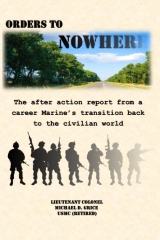
It’s here! Orders to Nowhere is now a book!

It’s finally here!  The first edition of Orders to Nowhere is available in print.  It will be six to eight weeks before it shows up in bookstores, and a week or so before it hits Amazon.com.  If you want to avoid the wait, you can order it straight from the printer by clicking the cover:

Orders to Nowhere

Since you are a loyal reader and follower of the blog that got it all started, you can use the discount code ZVGYFQ28 and save 10% off the cover price.

Thank each and every one of you for reading and following my journey through transition!

What’s next for military pay and benefits?

My last post was about the impending — and expected — drawdown of the military.  The United States is following the path of many other western nations as they shed soldiers and sailors in an effort to curtail the expense of national treasure and return their armed forces to the size they deem more appropriate for a post-war world.

It does make sense.  After all, standing armies, navies, and air forces are extremely expensive and tough to justify in times of peace (or at least of times of non-war, which seems to be a more apropos description of the 21st century age in which we live).  It has all happened before, and it will surely happen again.

For those who remain in uniform, however, things may well be changing as well.  The Department of Defense is considering pretty much any idea or option that comes to the table in terms of reigning in the costs of personnel, consume about a quarter of the DOD budget.  Various studies and commissions have examined the issue of military and military retiree compensation, and with the austerity brought on by the economy and sequestration such benefits come under greater scrutiny.

One of the latest efforts is the Military Compensation and Retirement Modernization Commission, a congressionally mandated effort to determine the “long term viability” of  military compensation (for more information, read today’s Stars and Stripes coverage of the commission here).  All things considered, looking under the hood of the military compensation machine is not in and of itself a bad thing.  It happens after every war, but this time the scalpels are sharp and the desire to perform some cost cutting surgery is possibly stronger than ever.

Efforts to change pension benefits, pay structures for serving personnel, medical coverage for retirees, and countless other benefits have been in the news lately and the new congressional panel is yet another bureaucratic mechanic crowded under the hood of the machine trying to dismantle what they can.

As I wrote earlier, a reasonable review is perfectly appropriate as the wars draw to a close.  The moral imperative of meeting the obligations of the nation to those who serve it, however, should be paramount in any discussion about tinkering with or cutting compensation.

I sincerely hope that the commission keeps that in mind.

Here it comes: the big drawdown

It seems that every day brings news about the future of the military, and today was certainly no exception.  The Army, according to a Thomas Ricks’ post in Foreign Policy, is about to start separating officers from the service.  (Click here to read it)

There has been a lot of howling about how sequestration is causing the downfall of the military, and that the danger of a hollow force is only a manpower cuts away, but in all practical reality the end of the wars in Iraq and Afghanistan make a smaller military inevitable.  It happens after every major conflict; the US Army numbered under 400,000 active and national guard troops in 1939, but by the end of the Second World War it had swollen to over 8,000,000. At the start of the Korean War some five years later the army was down to 630,000.

One of the principal reasons that the drawdown in the near future is different from those from prior wars is the composition of the force.  There are no draftees in today’s military.  Each and every Soldier, Sailor, Airman, and Marine volunteered to serve his or her country, and as a result more of them are likely to want to stay in the military than their predecessors.  At the end of the First and Second World Wars the armed forces (which were filled with draftees and wartime volunteers) shrunk naturally as people headed back to the lives they interrupted to go to war.  The same can be said for Korea and Vietnam to certain extent, as draftees were critical to expanding the armed forces to the size needed to fight those wars.

Today, though, we have no draftees.  Instead, we have a highly trained force of military professionals who have dedicated themselves to a career in the military.  Sure, the majority of first term enlistees serve one hitch and get out, but a significantly larger percentage want to stay.

Therein lies the rub.  As the military inevitably shrinks, the number of job slots that military folks can fill will decrease.  For the enlisted component of the armed forces, the length and terms of the enlistment contract can be used to decrease the size of the force; the military branches can make it more restrictive and difficult to reenlist. It is an effective manpower shaping tool.

For officers, however, the rules are very different.  Generally speaking, junior officers (ensigns and lieutenants) serve an initial contracted period (during which they are considered “reserve” officers), which is very similar to the enlisted side.  If they want to stay in, however, instead of reenlisting they compete for transition to from “reserve” to “regular” status.  Once an officer becomes a regular, his contract disappears and his term of service becomes “indefinite”.  This means that they are in until they 1) retire 2) quit 3) fail to get promoted or 4) die.  There is no enlistment contract to use as a force shaping tool.

During stable periods this is no big deal.  The services have staffing models that pretty accurately predict the size that the force needs to be, and they can manage the number of officers based on the number they are allowed to have by law, natural attrition, and accession of new officers.  During unstable times, though, like right now as we finish up a couple of wars, the models come apart like a trailer in a tornado.

The military had to significantly change its shape and size to fight the protracted counterinsurgent wars.  Many more boots on the ground were needed, which means that privates and second lieutenants were getting hired at the rapid rate (meaning much were donning the uniform than usual), and as time went on they got promoted to become sergeants and captains.  Enough time, in fact, that many of the officers became regulars.

Now that becomes a problem.

The enlisted side can be shaped using enlistment contracts, but the regular officers are immune from that shaping tool.  Instead, to reduce the number of officers (which is necessary to retain the proper shape of the force) the branches must figure out a way to get them to leave.  There are a lot of programs that are used to entice officers to leave (early retirement, “getting out” bonuses, etc), but when those do not get enough officers to leave the axe comes out.

In the Marine Corps the axe is the Selected Early Retirement Board (SERB).  Colonels and Lieutenant Colonels who fit a particular set of conditions are considered for retention or retirement.  Even though they can, by law, serve until their service limitations of 30 and 28 years respectively, the Marine Corps does not need them around for that long.  If they are selected for early retirement by the SERB, then they have about seven months to transition out to retirement.  The reason that such senior officers are targeted in the Marine Corps is that by lopping off people at the top it frees those below them to move up.

The Army is apparently about to do the same thing, except for a much junior set of folks: captains and majors. From Ricks’ blog post (a portion of letter sent from a senior officer to his or her juniors):

“You may already know, but there are going to be Officer Separation Boards (OSB) and Enhanced Selective Early Retirement Boards (E-SERBs) for Army Competitive Category Captains in Year Groups 2006-2008 and Majors in Year Groups 1999-2003 beginning in March 2014.

Initial word is that the OSBs and E-SERBs will select less than 10% of the considered majors and captains in year group 2008 and less than 20% of the captains considered in year groups 2006 and 2007.

I am meeting with the officers in the battalion affected that are physically at Ft. [DELETED] to discuss their Professional Development and future officer actions and will provide them an assessment of their potential for future service and potential risk of being selected for involuntary separation, and will help prepare their files for the boards. Additionally they are contacting their HRC Branch Representatives for an assessment. I recommend you find a trusted senior officer to do the same.”

The writing is on the wall.  Despite the promise of an exciting career in uniform, many officers are going to get the axe.  Is it good?  Is it bad?  I dunno.  In the mafia, they say that “it’s just business”.  The military needs to shrink, and it is not sequestration’s fault.  How the shrinking is done, however, says a lot about the moral contract between the institution of the military and those who serve within it.

Food for thought.

Orders to Nowhere: The Book!

Coming soon!  The launch date is expected by be no later than November 10th, but hopefully sooner. I’ll post a note as soon as it goes live.

Written over the two years of navigating the often frustrating and always confusing waters of military transition, Orders to Nowhere is finally available in print!

Orders to Nowhere is the essential insider’s guide to military transition.  Demystifying the uncertainty and ambiguity that surrounds getting out of the military, Orders to Nowhere is the comprehensive After Action Report of a career Marine’s transition from the tightly knit military world back to civilianhood.

Tens of thousands of Soldiers, Sailors, Airmen, Marines, and Coast Guardsmen transition back into the civilian world each and every year. The change from life in uniform to life beyond the military is a significant emotional event for everyone who experiences it. Hanging up your uniform for the last time isn’t easy, and Orders to Nowhere was written to help explain the overwhelming process and make it easier for military members planning to get out, while they are in the midst of transition, or after they become veterans.

Mike Grice is an award winning writer, retired career Marine, and intrepid explorer of the military transition process.  Orders to Nowhere is the journal of his experiences , but it is also the story of every Soldier, Sailor, Airman, Marine, and Coast Guardsman who takes off the cloth of the nation and goes back to civilian life.  Written during the author’s adventure through the trials and tribulations of transition, Orders to Nowhere eases the pain by giving an inside look at the widely varied aspects of military to civilian transformation.  Things like:

 -making the decision to hang up the uniform
– telling your boss that you are getting out
– the administration and logistics of moving on
– the emotional roller coaster of transition 
– effects on family
– transition decorum and ceremonies 
– the details of military retirement benefits
– transition assistance classes
– dealing with the Veterans Administration
– VA disability claims
– the Post 9/11 GI Bill
– finding a job
– how to dress like a professional
– writing a resume and cover letter
– networking
– interviewing for a job
– salary and benefits negotiation 
– adjusting to civilian life
– and much, much more

The book contains over 160 lessons learned and recommendations that can help anyone going through the military to civilian transition avoid making costly mistakes.  The path back to “normal” life is anything but normal, and Orders to Nowhere is the traveler’s guide that every member of the military and veteran needs to ease the pain of the journey.

A must for every man and woman in uniform to help make transition as smooth as possible!