Another plug for help!

Last week I wrote about a survey that I am conducting about the military transition process.  So far the response has been good (thanks to all of you who have already taken it!) but I am only about halfway there.  In order to have an unbiased survey it is important to get as many responses as possible in order to make sure that the sample of those of you who take the survey are representative of the entire population of transitioning or transitioned folks.  At the risk of being redundant, I ask again that if you have gone through or are going through the transition process and have not yet taken my survey, would you please help me out?  Also, please forward it to anyone, from any branch and any time period, who has made the jump?  I promise that this will be my last humble request!

The survey is 29 questions long and takes between 10 and 15 minutes to complete.  Here is the link:

Military Transition Survey

Also, I am very eager to hear from all of the branches of the armed forces.  The Marine response has been great (keep them coming!), and I want to make sure that you know that I would like to hear from any and all who have undergone the transition process.

Thanks!  In my next posts we’ll start looking at some of the emerging and interesting trends that the survey is revealing.

A chance to improve the military to civilian transition process

As those who follow my writings about military transition know, the process is often contrary, capricious, confusing, and supremely frustrating.  I have been writing about my experiences for nearly two years now, and over that time I have been disappointed to see that the process has not really improved.  Transition is still just as consternating as ever, despite millions of dollars spent on the process by both the Department of Defense and the Veterans Administration.

I am currently writing a book about my transitional journey, and that is where you come into the picture.  I have created a survey in which I am humbly asking every veteran and every military person who is going through transition or has completed transition to participate.  I have my own observations and opinions, but as author Eric Herzel once said: “One’s opinion should only be as strong as one’s knowledge on the matter.”

Since I am planning to write much more about transition, I really need to incorporate the collective knowledge of as many of you who have experienced transition in order to make my opinions as fact-based as possible.  Will you help?

Without further ado, here is:

Military Transition  Survey

Thank you in advance — and I will be posting the insights and results soon!

Learning a new skill: Salary and benefits negotiation part 2

A couple of posts ago we started talking about the final step in the job search: negotiating your salary and benefits.  The company has already offered you a job, and in that sweet and exciting period of time between receiving the offer and accepting it comes the negotiation to determine your compensation package with the company.

We have already looked at many of the differences between military and civilian employment benefits, so we won’t go too deeply down that rabbit hole other than to point out that many of the benefits on the military side of the fence are not freely offered by civilian companies.  Take, for example, the military subsistence (meal) and housing subsidies.  You get them while in uniform, but they don’t come freely in the corporate sector.  All of those special pays and allowances that fattened up your military paycheck helped mitigate the comparatively low pay that comes with wearing the uniform.  An added benefit is that those pays are tax-free, which in the corporate sector is almost unheard of.

As a military man or woman you are also free to shop in the commissary, gas station, and PX, all of which provide subsidized food and goods that are free of state and local sales taxes.  While retirees can still enjoy shopping on base, for those who do not stay in for 20+ years or move home and have no base nearby it is no longer possible.  The subsidies, coupled with tax free shopping, are not offered by the corporate sector.  Once you get out you get to pay full price for your groceries and consumer goods, and you get to pay sales tax, too.

My point is that many of the monetary and non-monetary benefits that you receive whilst in uniform went a looooong way towards stretching your paycheck.  When you get out all you have to pay your bills, buy food, and fill your tank with gas is the salary that you are paid by your employer.  Since that is how the “real” world works, you need to make sure to get the best benefit package you can from your employer, and to get such a package you need to be able to negotiate.

Negotiation is a skill, just like any other.  You can get better at if you work at it, and the best way to improve is to practice and rehearse, just like you should for a job interview.

Before you start rehearsing, though, you need to do your research (as discussed in the previous post about negotiation) and then you need to craft a plan of action to prepare yourself.  Just like you would do in the military.

Unlike military plans, though, yours does not have to be intricate or complicated.

Your plan should contain those elements of compensation that you feel are important to you.  It should also contain those elements of compensation that are not important to you.

Why should the unimportant bits be included you ask?

Because they are all part of the plan.  The art of negotiation is based on meeting mutual agreement, and getting to a point where both you and the Human Resources manager agree on your pay and benefits is based on the give and take that you both engage in during the negotiation process.  If you only have those things that are important to you on the list then you are at a disadvantage because negotiation invariably requires you to give a little to get a little.  You can give a little by sacrificing those things that are unimportant to you and, in turn, get a little something back that you truly want.

Here is an easy example.

You feel that flexible work hours are very important to you.

You also feel that health insurance is not important to you because you are single and already covered by the VA and TRICARE.

In the world of civilian employment the cost of health insurance is high and by all accounts only going to get higher.  The fact that you are willing to give up employer-provided healthcare is a significant savings to the employer.  Even though you never planned to use the company’s insurance you can “offer” to keep your current insurance plan (and save the company a lot of money) if you can have a flexible work schedule.

If you don’t have a plan to give up those things that you don’t really want or need then you are giving up a significant amount of leverage.  Be smart and plan your negotiation out!

Here are some basic planning considerations that I recommend you think about as you plan for your pay and benefits negotiation:

1.  What do you want from the company?  (Sure, you want a job, but what do you want in return for your time and dedication?)

2.  What does the company want from you? (Sure, they want an employee but generally want to pay as little as possible for one —  you will need to show the company that you are worth whatever you identify in the first question)

3.  What is the absolute minimum that you are willing to accept from the company?  (This is very important.  The Human Resources person has a lot more experience negotiating than you do, and if you are not careful they may well negotiate you out of the things that you think are very important).

4.  What is your alternative?  In official negotiating terms this is known as the “BATNA”, or Best Alternative To a Negotiated Agreement.  In other words, what are you going to do if the company is unwilling to meet your absolute minimum?  (This is also important because you want to leave the negotiation with a job and not burn any bridges.  The best BATNA is to leave the negotiation on good terms that can be leveraged into another negotiation with the company that is ultimately successful for you both).

After you put together your simple plan you need to do a little rehearsing just like you did for your job interviews.  Find someone to conduct a mock negotiation with, and then listen to their feedback.  It will pay huge dividends.  I guarantee that you will be surprised at just how difficult negotiating can be!  By rehearsing you will learn if you are too brusque or direct or overbearing, all of which are very common traits that come with military service.  You want to be convivial and professional because it is what the company expects, and by rehearsing with another person you can fine tune your style of engagement.

Here are a few things that military people tend to do while they negotiate that end up working against them:

– Being too rigid and organized.  Just because you have a plan doesn’t mean that you need to unyieldingly stick to it.  Do not treat your plan as a checklist and start at the top and work your way to the bottom.  The negotiation is a conversation that will go in many directions before it is completed, and if you are too mechanical and inflexible it will hurt you.

– Being unwilling to engage in a dialog.  Often, military folks are used to just accepting “no” a bit too easily.  Remember, the Human Resources manager wants to hire you as cheaply as possible, and if you just roll over every time he or she says no then you are making his or her job pretty easy.

– Being ignorant of what benefits are available for discussion.  This goes back to the previous post about interview preparation: make sure to do your research!  If you do not ask for something I guarantee you will not get it.  At this stage of the game nobody is looking out for you except you!

– Being ignorant of how much money they really need to make.  A good rule of thumb is that you need to nearly double your base military pay to obtain the same level of compensation in the civilian world.  Taxes go up and tax-free benefits go away.   In the civilian world you get to pay bills that you may not have thought about: for example, if you lived in the barracks or in base housing you did not have to pay for electricity, water, natural gas, or trash removal.  Guess what- in the civilian world you get to pay for all of those things and more!

__________

Lessons Learned:

– Do some research on your own finances and see just how much money that you are going to need in the civilian world.  Remember- taxes take a big bite!  If you were in the civilian world you could count on 30-40% of your BAH and Subsistance Allowance to go to the IRS because it would be counted as income.  Find out how much money you really need.

– List out those benefits that are important to you and also those that are not.  You will use both lists during your negotiation.  Make sure that those benefits you want are offered by the company!

-Rehearse with someone — you need the practice.  Remember, the Human Resources manager does this a lot more than you do.

– Find out what your BATNA is and stick to it- it is OK to walk away from the negotiation if the result would be below your absolute minimum level of acceptability.

The call I was waiting for from the VA. Really!

It finally happened!  The VA called and scheduled my final disability evaluation appointment.  Hooray!

For those who are wondering why this is a big deal, here is a quick backstory.  My veteran’s disability claim has been turgidly moving through the system for nearly a year and a half, and during that time I also entered the VA medical system.  As I learned, the VA has two distinct and different sides when it comes to disability claims and healthcare, and they do not talk.

This became a problem for me because I did not understand that important fact.  My disability claim was partially settled six months ago, and with the notification letter came the promise of a call to finish the process.  Soon after, I was contacted by the VA on numerous occasions to schedule and attend various appointments at the local clinic.  Foolishly, I thought that the clinic and the disability claim evaluation were one and the same.  As I said earlier, they aren’t.

As it happens all of the calls from the VA clinic were for the medical side and were unrelated to the disability claims side, and none of the appointments had anything do to with my claim.  Good news for my medical coverage, but still a lot of frustration on my disability claim.

So, months of frustration, I called the VA.  After a few weeks of phone tag, my case was reviewed and I was again promised that I would be receiving a call to schedule my follow up appointment.  I was not optimistic.

My pessimism was abated when they called.  Actually, they contacted me by mail. I received a letter that explained that I needed to be seen by the VA’s contract provider for a few things that were not completely documented by my initial visit, and with the letter came a questionnaire regarding the issues in question.  I filled out the questionnaire, and within a day or two I received a call from the provider’s office to schedule an appointment.

Yesterday I went to the contract provider that takes care of the claims side of the VA house.  It was the same provider that I had seen a year earlier, and to their credit they were very efficient and polite.  I was in and out of their office in less than 45 minutes, which was a pleasant surprise as I had anticipated spending the afternoon in the waiting room.  With that appointment I had, in theory, finished up my claims process.  I hope it is done.  According to the VA representative that I had spoken with earlier the only items remaining in my case were the evaluation from the contract provider and a few administrative corrections in my file.

The evaluation is done.  Now I just have to wait for the administrators to correct my file and then my disability claim should be completed.

I’ve heard that story before.  We’ll see…and I’ll keep you posted!

__________

Lessons learned:

– The Medical side of the VA is completely separate from the Disability claims side of the VA.  In my case, the clue to the difference was that all of the medical issues were addressed by my local clinic while all of my disability evaluations were performed by a contracted provider.

– Be proactive.  Call the VA and determine your status.  I think it helped, as my case was languishing for months until I made some inquiries.

– As always, be patient!

Learning a new skill: Salary and benefits negotiation part 1

In the military one learns a good many things:  How to stand at attention and march smartly about.  How to carry and shoot a rifle, and how to live out of a backpack for weeks on end.  How to fix a tank or fly a jet.  Lots and lots of things.

One thing that you don’t learn, however, is something that everybody else in the business world learns with their first job: how to negotiate.

Negotiation is a very important part the employment process.  When a candidate is offered a position with a company he or she begins the discussion of compensation with the hiring manager, where things like compensation, benefits, hours, vacation time, career progression, retirement plans, insurance, and countless other things that are part and parcel of employment.  In the corporate world all of these items are negotiable, and both job providers and job seekers know it.

In the military the situation could not be more different.  When a young man or woman joins the military they are provided a comprehensive pay and benefits package, but it is one that is set by law and regulation.  There is no negotiation for a better salary or more flexible hours — in fact, there is no negotiation at all.  The pay, allowances, and benefits for military folks are no secret, either.  The pay scale, which is based on rank and time in service, is readily available on the internet as are all of the other  benefits, special pay conditions (such as jump and dive pay), and housing stipends.  When you join the military you get what you get, just like everybody else in uniform.

As a result of the defined pay and benefits in the military those in uniform never engage in the process of employment negotiation, and that can place them at a disadvantage when they hang up their uniforms and enter the civilian world where everything is negotiable.

Everything from the salary you will earn to the amount of vacation you can take to where you can park your car is on the table.  It is up to you, the job seeker, to get the best offer that you can, and if you don’t know to engage in the back and forth of negotiation then you risk leaving valuable things on the table.  There is one guarantee in negotiation: you will never get things that you don’t ask for.

Fortunately, you can arm yourself for such a negotiation by doing a little research and preparing for it.

The research bit can make an enormous difference in the negotiation process because it can provide you with valuable information about the company and what you can and can not ask for.  You can surf the internet (at sites like www.glassdoor.com or www.payscale.com) and ask your friends and contacts (especially those in the industry you are entering or work at the company) about what the average salary for your desired position is as well as the benefits package that the firm offers.

As the job seeker you have leverage in the negotiation up until the point that you accept the job offer and the terms that it contains.  Once you say “yes” the negotiation is over, and you are highly unlikely to be able to change anything.  At that point anything that was left on the table will vanish like a thief in the night.

So what are the types of things that you can ask for?  Here is a quick list of twenty things that many companies will entertain and which may or may not be similar to military benefits:

1.  Performance bonuses.  Can you make more money if your performance merits it?

2.  Flexible hours.  Maybe a four day week with longer workdays?

3.  Work location.  Work from home?

4.  Overtime pay.  How much will you be compensated for working extra hours?

5.  Retirement plans.  What kind do they offer?  How much will the company match in a 401K?

6.  Vacation time.  You received 30 days a year in the military, and the base in the civilian world is two weeks, unless you negotiate for more.

7.  Travel expenses.  Can you get  company car?  Mileage compensation or a gas station credit card?

8.  Non-monetary compensation.  Can you earn stock options or fully valued shares of the company’s stock?

9.  Career flexibility.  Can you create a path that starts in one area of the company and then move to another?

10.  Time off.  How about personal days?  Sick days?

11.  Health care.  Is health insurance included?  What are the deductibles?  Is there an on-site clinic?

12.  Insurance.  You had SGLI in the military at a steeply discounted rate.  Does your employer offer life insurance?

13.  Meals.  Is there a company cafeteria?  Are meals subsidized?

14.  Child care.  Can you bring your child to work?  How about a nursing room for those who wish to nurse their infants?

15.  Tech equipment.  How about a company phone or laptop?

16.  Discounts.  If the company produces goods, can you purchase them at a discount?  Is there a company store?

17.  Memberships.  Will the company provide memberships to a health club or gym?

18.  Travel.  Will you be expected to travel in coach, business class, or even better when you travel?  How about upgrades?

19.  Education.  Will the company pay for you to pursue an MBA or other educational opportunitity?

20.  Relocation expenses.  Will the firm pay for you to move your family to the city where you will work?

These are only the tip of the pay and benefits iceberg.  If you don’t do your homework and come to the bargaining table knowing what you can and should ask for you will get less than you could have.

In my next post we will prepare for the negotiation by rehearsing and doing a little self examination to make sure we do the best job possible at the bargaining table.

__________

Lessons learned:

– Military benefits are set.  Corporate benefits are not.  To get the best salary and benefits possible you are going to have to negotiate for them.

– Not all companies offer all benefits.  You need to do some research to see what the company offers, and then be prepared to ask for them.

– Salary is usually the biggest aspect of the negotiation, but it is not the only element.  Unlike the military, many corporate benefit packages are tailored to the individual employee.

– Use your network of contacts and the internet to research what will likely be on the table during the negotiation.  Don’t look foolish by asking for something the company does not offer, and don’t forget to ask for something that they do.

A call from the VA. Finally!

Well, the VA finally called me back.  For those readers who may be unfamiliar with my ongoing saga with the Veterans Administration, here is a quick recap:

My disability claim is well into its second year.  Some six months ago I was informed that my claim was partially completed, with about half of the identified conditions being adjudicated.  I would be “contacted” by the VA to schedule appointments which would take care of the unresolved issues.

So I waited for the call.  For five months I waited, and finally decided to take the initiative to call them instead of spending another day being deafened by the sound of no telephones ringing.  After a week of failed attempts, I finally reached a real live VA representative!  Together, we reviewed my case and initiated an inquiry that required the team that was actually working on my case to contact me and explain its status.  In ten working days.  Or less.

They never called.  So, at day twelve, I called them.

I eventually ended up speaking with another VA representative who (again) reviewed my case.  She determined (and was quite annoyed to report) that the team who was evaluating my case had indeed seen the inquiry, but had simply marked it closed and not bothered to contact me.

Nice.

She apologized and placed a note in the electronic file to her boss and the team that was supposed to contact me.  Whether or not they would actually call me back she could not say.  To her credit, she was very professional and really helpful.

Well, two weeks later the VA called back.

I don’t know if the gentleman who initiated the call was on my team or not, but he did explain the status of my claim.  It turns out that one of the remaining conditions requires an actual physical re-examination, but the others required administrative corrections (which, in his words, consist of checking different boxes on the processing forms).  Don’t worry, he said, I would be contacted soon (!) by the VA to schedule the appointment.

I won’t hold my breath.

He followed by instructing me to call two weeks after the appointment as a follow up.  Apparently, since my case is in the review stage it will not lose its place in line and go back to the beginning because all that is required is for the printouts from the examination and the corrected process forms to be placed in the file.  If I call, he said, it will make sure that the file keeps moving forward.

So now I am in week two of waiting for the call to schedule my appointment.  I’ll keep you posted…

__________

Lessons learned:

– Be proactive.  My experience shows that the squeaky wheel gets the grease, and particularly if the VA promises something that they do not deliver.  Make sure to record names, dates, and times of your calls and reengage with the administration immediately after they fail to achieve a timeline milestone.

– Be patient.  It is not going to be a rapidly resolving process.  If you get angry, all you will do is slow it down.  I know it is incredibly frustrating at times, but the people on the other end of the phone are overwhelmed by a byzantine bureaucracy.  Don’t vent your frustrations at the messenger because you may find your file at the bottom of the pile.


An opportunity for Combat Veterans

I have written about the opportunity that Veterans 360 presents for transitioning veterans.  For those who may not have read my prior posts on what they do, here is a refresher:

It is very challenging to make a quick and successful transition from military to civilian life.  There are many obstacles that you encounter along the way, many new things to learn, and a unique set of experiences that you never want to forget.  It can really be daunting and confusing at times for any veteran to make the change back to civvie street.

It is particularly daunting and confusing for those veterans who are struggling with the effects of Post Traumatic and Combat Operational Stress as they leave the military.  Combat veterans, in particular, have a more difficult time making the transition.  I have spoken with many who are making the shift, and one theme comes through in every conversation: “What am I gonna do now?”

Being a transitioning Marine intimately familiar with the realities of PTSD myself I can fully relate.  It is tough to make the change from one way of life to another, and it is much more difficult for those with stress injuries as they wrestle the demons within while trying to adapt to a new life without.

There is an organization that I am affiliated with that aims to help combat veterans successfully navigate the challenges transition.  Veterans 360, a nonprofit organization headquartered in San Diego, is kicking off what I believe is a great program to help combat vets make a successful transition.

Here is their mission:

Veterans 360 has a clearly defined mission: to provide recently separated combat veterans with a carefully developed and managed program of support that will help them develop the professional and interpersonal skills needed to succeed in civilian life. Our goal is that through engagement, education, employment and healing, our student-veterans will utilize what they have learned, manage the resources that are available to them and become equipped for an exceedingly successful transition into civilian life.

They help vets by bringing them into an cohesive and immersive environment for the crucial first two months after leaving the service.  Veterans 360 brings a dozen or so combat vets together, forming a “squad” that will go through an integrated and comprehensive transition program together.  They will work live together, work together, and heal together in an environment that centers around engagement with the local community, education focused on basic skills and vocational training, employment facilitation that will help them find meaningful work, and healing to help deal with PTS.

All of this is accomplished through individual and corporate donations, and not one thin dime of the veteran’s post-service VA or other benefits will be touched.  This is a critical point, as many unseemly organizations and “educational” facilities have sprung up with the cloaked goal to separate the veterans from their money.  Veterans 360 is proudly not one of them.

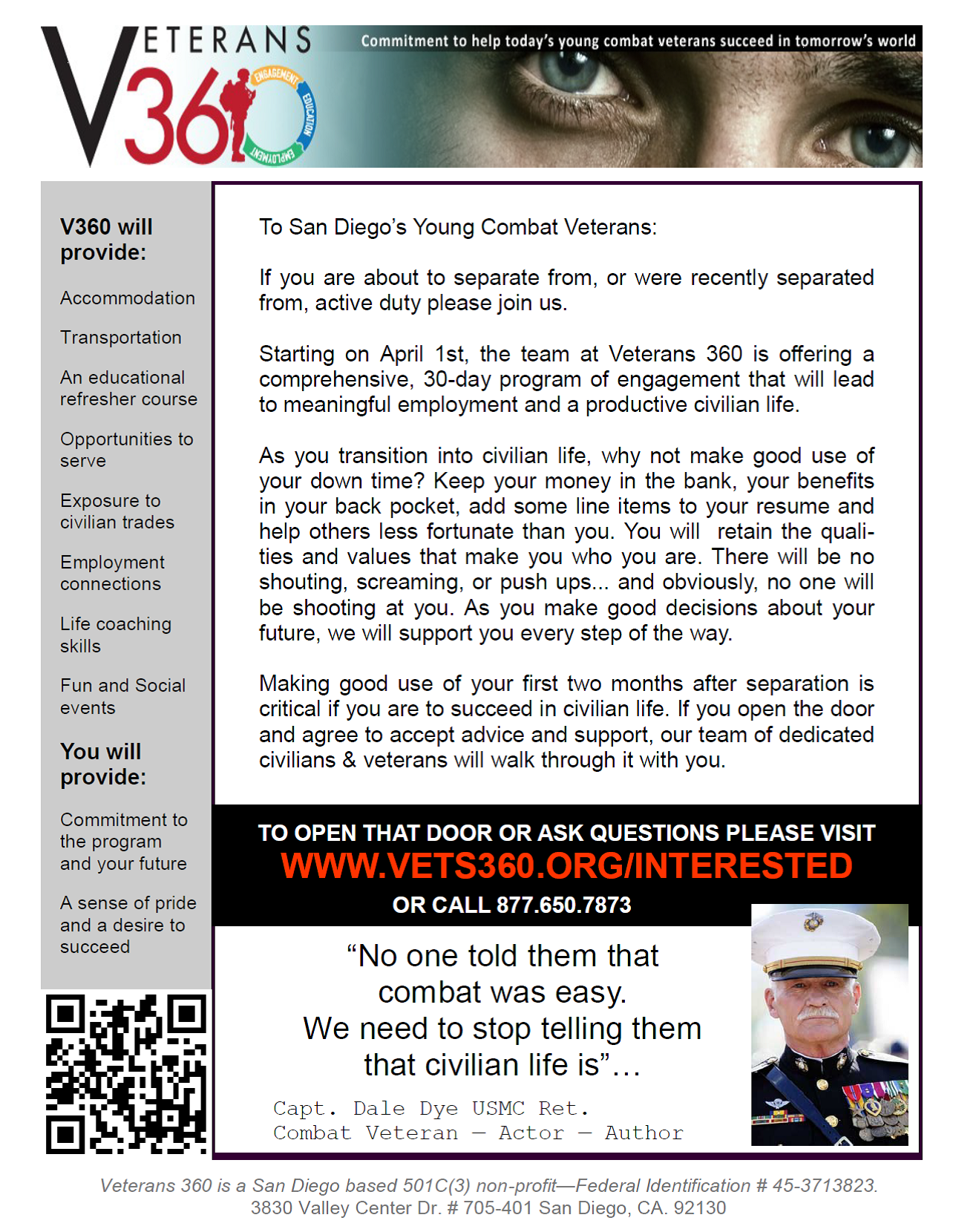
Veterans 360 is about to kick off their inaugural squad engagement on April 1st of this year.  They are looking for candidates to participate in the program.  The details of the initial effort are listed in their recruiting poster:

Veterans 360 Recruiting Poster

If you are a combat veteran in the San Diego area who is looking for something innovative to help with your transition, check it out!

The sound of no phones ringing as my VA saga continues

In my most recent post I lamented about the languishing status of my service connected disability claim.  It had been partially settled, but half of the conditions under review still required action and that action was very long in coming.  It is month seven and counting since I was informed that “I would be contacted” by a VA representative to continue the work on my claim.

At month five or so I called to see what was up.  After many failed attempts, I got up extra early and called when the call center opened, and after being on hold for a half hour I was able to speak to a representative.  Long story short, he initiated an official inquiry which included the promise that I would receive a telephone call from the regional office that was working my claim.  In ten working days or less.

Well, ten days came and went, so this morning I again got up extra early (well, not that extra early because I get up before 0500 anyhow) and I called the VA.  After navigating the automated menus I was informed that I would be on hold for 22 minutes, so I waited.  45 minutes later a voice broke the elevator-esque hold music monotony and asked how she could help.

I explained my dilemma, and she pulled my information up on her computer.  I heard the clattering of her typing on her keyboard along with a sigh.

“They did not call you?” she asked.

“Nope.”

“They marked it closed, but there are no notes that show a call was conducted…”

Great.

It turns out that my Official Inquiry had been marked closed with no action taken.  No call.  No notes.  No action on my claim.

I was a bit annoyed, and she was a bit perplexed.  I got the feeling that I was not the first person that she had spoken to with this problem.  To her credit, she calmly explained the next steps as she typed away.  She notified her local supervisor as well as the supervisor and the team that was supposed to contact me about the problem, and apologized for the whole incident.  She went so far as to say that whoever closed my inquiry had actually lied about it and not done their job.  She said that someone may call me to update me on the status of my claim, but she also wisely did not promise that anyone would actually pick up the phone.  Neato.

As for my claim, she further explained that the crux of the problem was that while my issues had been partially resolved (with a completed disability rating for half of my identified conditions) the remaining issues would be addressed in the future.  How far in the future she could not say.  Eight months was the average for the initial claim (which was close to my timeline), but there was no expected timeline for the rest of the issues.  It could be a day, a week, a month, a year, or more.  Neato again!

So there you have it.  My first call resulted in a promise of a call back that never came.  My second call resulted in a complaint that nobody called, and I don’t know if anyone ever will.  Time will pass, I suppose, and maybe my phone will ring.

I won’t hold my breath.

__________

Lessons Learned:

1.  Stay on top of the process!  If you are promised a phone call, follow up if you do not get it.

2.  Call early in the day and you will get through.  Eventually.   My experience is that your wait time is twice the amount of time announced, so get a cup of coffee or two and read the paper because it is going to take a while.

3.  Don’t get angry.  The person on the other end of the phone is a person too, and they had nothing to do with your particular issue.  If you make them angry they will not be helpful.  Remember the golden rule!  Be nice and help them help you.

Still waiting for the call that may never come…

My last post left all of us hanging in anticipation of a call from the VA in regards to my disability claim.  You see, I had called and called the VA’a customer service number during the day with no luck whatsoever.  After finally getting up waaaaay before the crack of dawn I called again and finally got ahold of a VA representative.  We reviewed my case, and he agreed that something was amiss.  He promised that a representative would call in the next ten working days to let me know what was up.

I cheerily hung up and waited by the phone like a thirteen year old waiting for a girl to call and invite him to the Sadie Hawkins dance.

Well, it is now working day number nine.  No call.  No dance.

I have been holding my breath so long that I have gone from blue to purple.  They are not late yet.  One day to go!

I wonder if they will call?

The anticipation is killing me!  If they do, I will write a post to tell you how it went.  If they don’t, I will write a post to tell you how it didn’t go.

I think I see a zero dark thirty phonecall to the VA in my future…again.

It was the appointment I was looking for…sort of. The continuing saga of my life with the VA

Every once in a while things make sense.  Unfortunately for my journey into the world of the Veterans Administration, that once in a while has not happened yet.

You may recall from my last post that two seemingly unrelated and paradoxical events occurred that centered around my VA disability claim.  Within the span of a single week I first received a telephone call to invite me to an appointment at the local veterans hospital, which I took as an augury that my claim was turgidly stumbling forward, and I secondly found out that my claim was marked “CLOSED” on the VA’s ebenefits website (which is the interface that veterans use to access their VA benefits information: ebenefits.va.gov ).

One step forward and a huge leap back?  To say I was confused would be a gross disservice to the concept of understatement.

At any rate, I showed up for the appointment earlier this week and learned a little more about how the various processes at the VA work, or at least are supposed to work.

Unbeknownst to me, my appointment was based on the interview that the VA social worker had conducted on the day I officially became a consumer of VA health benefits.  The survey identified some items in my history that required further evaluation, and the appointment that I attended a few days ago was one of those items (in this case, it was for a Traumatic Brain Injury, or TBI, evaluation that was warranted because of my close proximity to noisy exploding things while in Iraq).

Fast forward to earlier this week.  I checked into the medical center, and after filling out yet another questionnaire about various things related to my mental state I was called to see the doctor.  After a brief introduction, I followed her through the physical therapy section of the hospital to a small office tucked away behind the treadmills and medicine balls.

I spent the next 45 minutes or so answering questions about the noisy things that exploded in my vicinity and the possible effects that they could have on me these many years later.  She then performed a series of physical examinations.  After getting whacked on the knee and following her finger with my eyes and a dozen or so other tests she announced that I was unlikely to be suffering from any long term effects of getting my bell rung in combat.  “Maybe a slight concussion,” said she, “but you seem fine to me.  Any questions?”

Ahhh.  Finally.  I did have a question or two.

I inquired as to the purpose of my visit.  Was I here for a disability related evaluation?  I explained my confusion, and she gave me the patient smile of someone who has explained this to people a time or two before.

“No.  This exam is based on the social worker’s evaluation from the VA clinic.  It has nothing to do with the disability claim process.”

She saw my blank and vacuous stare, and continued.

“We don’t have anything to do with claims.  The systems are completely separate.  If they want, they can access the records of this appointment, but that is up to them.  We are the medical side, not the disability claims side of the fence.”

With that bit of insight the lightbulb went on in my head.  Suddenly I understood why the two events that had occurred a month previously had confused me: I mistakenly thought that I was dealing with one agency when in fact I was dealing with two.  And neither of them talks to each other.

How governmentally bureaucratic!

The medical side had set the appointment, and it was proof positive that the system (or at least their half of it) worked.

The claims side, on the other hand, clearly had something wrong.

With that shocking bit of knowledge, I set out to find out just what was amiss with my disability claim.  I called the toll-free number for the VA.  Not once.  Not twice.  Not three times.

I won’t bore you with how many times I pounded the keys on my phone trying to reach a VA counselor, but after many fruitless attempts I resorted to calling at 5:20 in the morning in an effort to get through.  It worked.  After waiting on hold for nearly 30 minutes, I finally found myself at last in contact with a real live VA person!

I explained my dilemma to the gentleman, and he looked into it.  Apparently the ebenefits website was depicting the results of the most recent review that my case file had received and was incorrectly showing my status as closed.  What had occurred was that my file was being reconciled to determine what still remained to be done, and once that reconciliation was completed that review was posted as closed.

For whatever reason (which the VA rep could not explain) the ebenefits site “sometimes” picks up the wrong status.  I was one of the lucky few to fall in the wonderful world of “sometimes”.  Fortunately, my case was still open.  The status on the website was wrong.  Unfortunately, there was also no indicator of progress in my case, so it really didn’t matter what the website said.  I was still going nowhere fast, but apparently I am making good time.

Sensing my consternation, the VA rep offered to initiate an inquiry.  The inquiry, he explained, means that someone in the office that held my claim would have to call me within the next ten working days to explain what was going on.

Hooray!  All I have to do now is wait for the phone to ring and then I will be able to talk to somebody who can explain just what is happening with my disability claim.

All I have to do is wait.

__________

Lessons Learned:

1.  The VA medical system and the VA disability claims system are two unrelated and unintegrated silos.  They each are performing their own important mission, but they do so independent of each other.  Make sure to find out which side of the fence your appointments fall on, or you will end up confused like I did by assuming that a medical appointment was for my disability claim or vice versa.

2.  Calling the VA during working hours is pointless and annoying.  There is supposedly a callback feature that you can use if you call after working hours, but I could never get it to work.  I resorted to calling early in the morning, right about the time that the call center opens, which is listed as 7:00 am Eastern time.  The number is 800-827-1000.  Good luck!!

3.  Write everything down, including the inquiry tracking number and the name of the person that you talked to.  It will be useful later on in case the inquiry gets lost or the information that you received turns out to be erroneous.