An opportunity for Combat Veterans

I have written about the opportunity that Veterans 360 presents for transitioning veterans.  For those who may not have read my prior posts on what they do, here is a refresher:

It is very challenging to make a quick and successful transition from military to civilian life.  There are many obstacles that you encounter along the way, many new things to learn, and a unique set of experiences that you never want to forget.  It can really be daunting and confusing at times for any veteran to make the change back to civvie street.

It is particularly daunting and confusing for those veterans who are struggling with the effects of Post Traumatic and Combat Operational Stress as they leave the military.  Combat veterans, in particular, have a more difficult time making the transition.  I have spoken with many who are making the shift, and one theme comes through in every conversation: “What am I gonna do now?”

Being a transitioning Marine intimately familiar with the realities of PTSD myself I can fully relate.  It is tough to make the change from one way of life to another, and it is much more difficult for those with stress injuries as they wrestle the demons within while trying to adapt to a new life without.

There is an organization that I am affiliated with that aims to help combat veterans successfully navigate the challenges transition.  Veterans 360, a nonprofit organization headquartered in San Diego, is kicking off what I believe is a great program to help combat vets make a successful transition.

Here is their mission:

Veterans 360 has a clearly defined mission: to provide recently separated combat veterans with a carefully developed and managed program of support that will help them develop the professional and interpersonal skills needed to succeed in civilian life. Our goal is that through engagement, education, employment and healing, our student-veterans will utilize what they have learned, manage the resources that are available to them and become equipped for an exceedingly successful transition into civilian life.

They help vets by bringing them into an cohesive and immersive environment for the crucial first two months after leaving the service.  Veterans 360 brings a dozen or so combat vets together, forming a “squad” that will go through an integrated and comprehensive transition program together.  They will work live together, work together, and heal together in an environment that centers around engagement with the local community, education focused on basic skills and vocational training, employment facilitation that will help them find meaningful work, and healing to help deal with PTS.

All of this is accomplished through individual and corporate donations, and not one thin dime of the veteran’s post-service VA or other benefits will be touched.  This is a critical point, as many unseemly organizations and “educational” facilities have sprung up with the cloaked goal to separate the veterans from their money.  Veterans 360 is proudly not one of them.

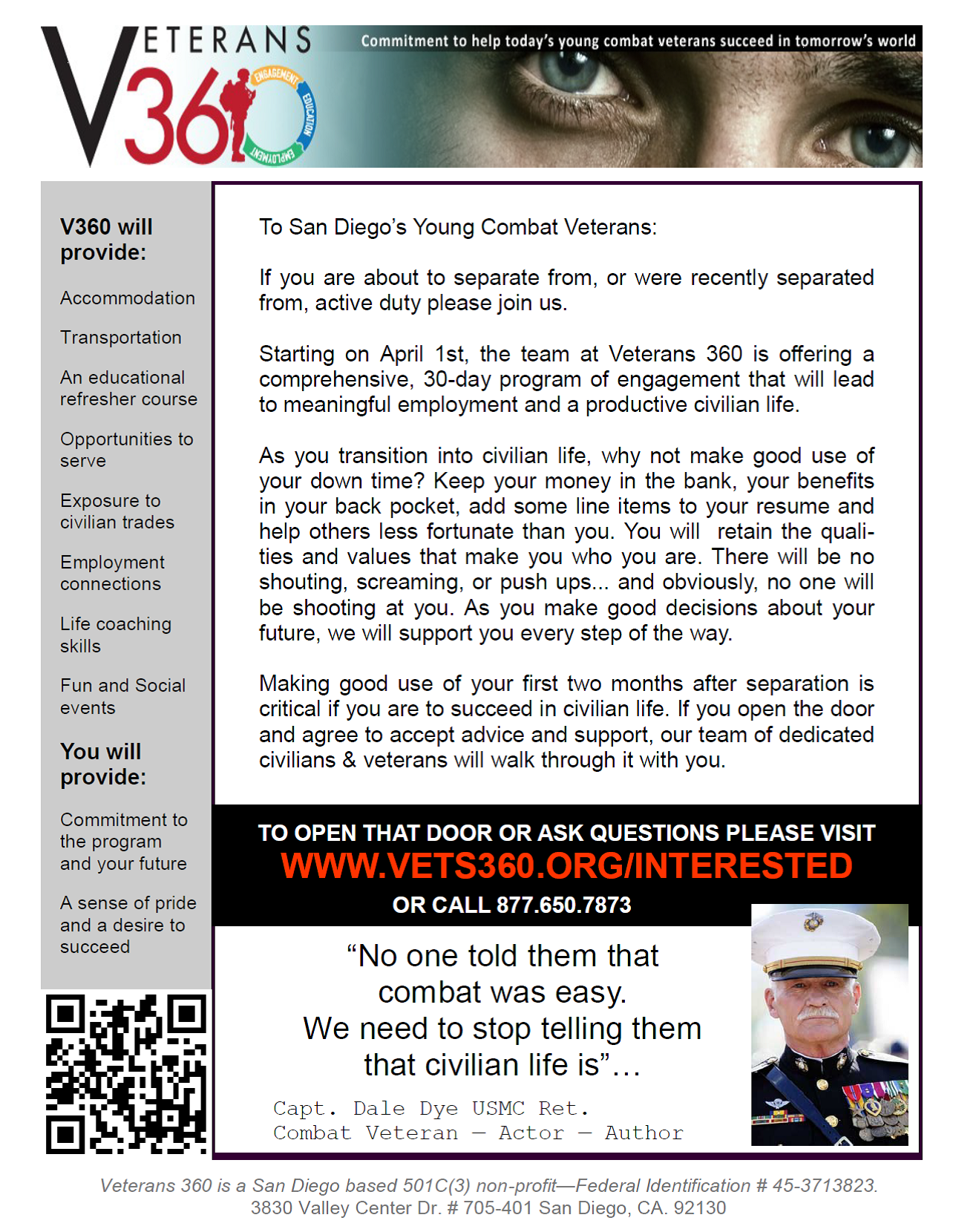
Veterans 360 is about to kick off their inaugural squad engagement on April 1st of this year.  They are looking for candidates to participate in the program.  The details of the initial effort are listed in their recruiting poster:

Veterans 360 Recruiting Poster

If you are a combat veteran in the San Diego area who is looking for something innovative to help with your transition, check it out!

After the interview: Now what?

So you have just finished interviewing with the company of your dreams.  As you walk out the door you need to remember, though, that even though the meeting part of the interview is over the whole process is not yet done.  You still have some work to do to finish it up.

Or, if you don’t want the job that badly, you can just get in your car, drive home, and have a cold one to celebrate the time that you wasted on the interview and the job opportunity you missed out on because your competition is going to go the extra mile and finish their interview properly.  The choice is up to you.

The smart thing to do is to continue to treat the job interview like a date.  Just as you want your relationship with a pretty girl or handsome guy to get more serious the same can be said about your interest in the company.  You are certainly curious as to how things went during the interview because you to want to step things up a notch and get into a meaningful relationship with the company.  Just like you want your date to call you back the day after dinner and a movie you desperately want the hiring manager to give you a ring with good news.

Even though you have left the building there are still several things you can, and should, do to increase your chances to land a job.  If you don’t do them the worst that will happen is that you won’t land an offer.  If you do the following things, though, you still may not get a job but you will come away from the experience with a stronger reputation and a better understanding of how to become a better candidate for employment.  Here, in my humble opinion (and in the opinions of many hiring managers) are the things that you should perform after the interview:

1.  Make some notes about the interview.  What questions were you prepared for?  What questions were you unprepared for?  What was the interviewer’s name and title?  You should have exchanged cards during the interview, and the back of the card is a good place to jot down the interviewer’s preferred form of address (“Mr. Smith” or “Bob”, for example).  You should take notes while the interview is fresh in your mind because otherwise you will forget those brain-hiccups that you had, and if you forget them then you are likely to repeat them again in future interviews.  I recommend getting a small notebook dedicated to the interviewing process and using it as a logbook or journal to record your post-interview notes.

2.  Send a follow-up note to thank the interviewer for their time and attention.  In the note make sure to use their preferred form of address (that you remembered to write down on the back of their business card as soon as you left the interview) and be sincere in your message.  You should be professional and courteous, but not overly familiar.  After all, you are still making an impression, and a poorly written note will do more harm than good.  Here is an example of a short and acceptable thank-you note:

Dear Bob,

Thank you for the opportunity to meet with you on Tuesday.  I am very excited about the opportunity to join XYZ Company, and I learned a great deal about the firm during the interview.  Our discussion about the corporate culture and dynamic work environment reinforced my strong desire to join the company, and I think that my skills and experience are a great fit for the _________ position.  I feel that I can be a strong contributor to the firm.

If you need to contact me for any follow up questions or additional information I can best be reached at xxx-xxx-xxxx or via email at mike@anymail.com.  I look forward to hearing from you soon.

Sincerely,

Mike Smith

3.  As you close out the interview ask the hiring manager for the best way to contact them in the future.  This is important because it gives the interviewer an opportunity to establish expectations for future communications.  He or she may be open to a call or email or may prefer that you wait to hear from the company before you contact them.  Make sure to pay attention!  You can shoot down your chances at a job if you call them after being asked to wait.  Just follow their lead.

4.  Think hard about your experience at the interview.  Are you going to be a good fit at the company?  Did you learn anything that was unexpected or that is not in line with your goals?  If you did, then do some serious soul-searching in order to decide whether or not to continue pursuing a job there.  Don’t just take the first job that comes along if it is not a good fit.

5.  Be ready for the company’s call.  It may be a letter, an email, or a telephone call, but regardless of how the firm reaches out to you the news will be either good or bad.  This is where character really counts; if the news is good then it means that you have a follow on interview in your future or a job offer letter on the way.  If the news is bad then it means that you will need to look elsewhere for a job.  If the news is good then you need to be humble, respectful, and thankful for the opportunity to work with the company.  If the news is bad, then you need to be humble, respectful, and thankful for the opportunity to interview with the company.  Even though you did not land a job with that particular company it doesn’t mean that you can be a jerk about it; remember, you are building a reputation along with your resume.  If you are obnoxious because you didn’t get the job the word will get out.  If you are respectful, the word will get out too.  The hiring manager who did not hire you may know of a company that is looking for someone with your skill set, and if you make a strong positive impression it may help network you into a new opportunity.

Remember that the hiring process does not end with the interview.  It ends with either a job offer, an invitation for a follow on interview, or a rejection.  You can improve your chances for a job offer by following up on the interview.

__________

Lessons Learned:

1.  Write down your impressions of the interview as soon as possible so that you can learn from it.  You want to make your strengths even stronger and eliminate your weaknesses, and the only way to effectively do that is to learn from your experience.

2.  The interview is not over when you walk out the door.  Hiring managers are people too, and sending a thank you note for their time is a nice touch that will be noticed.  It is a normal part of the hiring process, and if you don’t send a note then you are behind others who do. Send the thank you note immediately after the interview.  If you had to travel to the interview, then write the note and drop it in a local mailbox to ensure that it arrives quickly.  As the saying goes: “Strike while the iron is hot.”

3.  Reflect on the interview.  Did it reinforce your desire to work there or uncover some negative aspects about the job or the company that make you have second thoughts?

4.  Be gracious when you finally get the results of the interview.  This may take a while because the hiring process at most companies takes time, so be ready to wait.  When you get the news, be respectful and courteous regardless whether it is good or not.  Remember, your reputation is always growing, and if the word gets out that you are a jerk it will hurt your chances elsewhere.

Interviewing, Part 4: Military-specific considerations

As you interview for your dream job there are a few considerations that you need to keep in the back of your mind.  Unlike civilians who are free to pursue any and all employment opportunities, you may actually be precluded from taking advantage of some of the prospects out there because of your status as a member of the military.

There are several areas of consideration that can seriously affect your future career and, if you are not careful, cost you thousands of dollars or land you in jail.  This is not an all-inclusive list or discussion on the subject, but instead a look at three aspects of post-military employment that can get you into trouble.

First is the most obvious one: your security clearance.  When you leave active duty your clearance becomes inactive.  That said, if you join a company during terminal leave or accept employment with a firm that requires a clearance before you get out, the company can keep your clearance active by adding you as an employee and sponsoring your clearance.  If, however, you are unemployed (technically, even for one day) after you get out then your clearance will need to be reactivated.  You have up to two years for reactivation, unless your reevaluation date is less than that.  Top Secret clearances, for example, have a five year shelf life.  If you get out at year four, then it is only good for another year.  So you need to be careful on your resume and be sure to list your accurate clearance status (e.g., “Top Secret Clearance active until 2014” or “inactive Secret Clearance”).  You don’t want to misrepresent yourself as having a clearance that has lapsed or expired!

Second is the concept of Conflict of Interest.  In a nutshell, this is a situation in which your work while in uniform places you in a unique position to either profit from your position or have undue influence over the matter at hand.  An example of this is a contracting officer who can influence the spending of government dollars on a particular contract; he may be enticed to choose one bid over another if his future job depended on it.  The same goes if he influences his military connections after he gets out to bias a contract decision.  Not all instances of conflict of interest are as obvious, however.  If you are seeking a job in your specialty area (which is perfectly logical and normal) it is a good idea to get a copy of the job description and show it to a Staff Judge Advocate (military lawyer).  They can give you an opinion as to whether it conflicts or not.  This is a big deal because often the simple appearance of a conflict may create problems whether a true conflict exists or not.  Better safe than sorry….

Lastly, and most interestingly, is the rule against foreign employment.  The Emoluments Clause of the U. S. Constitution prohibits any person “holding any office of profit or trust” in the Federal Government from accepting any gift, emolument, office, or title of any kind from any foreign state without the consent of Congress – and that includes retirees.  In order for you to work for a foreign government you must first receive permission from your service secretary, as in the Secretary of the Navy, Army, or Air Force.  Needless to say, this is not a simple process!  You will need to apply for a waiver from the Secretary in advance otherwise you are breaking the law and the government may come after you to recoup the monies that you received up to the amount of your retirement pay.  Ouch!

__________

Lessons Learned:

1.  Your security clearance is a big deal for many employers because obtaining one costs thousands of dollars, and if you have an active clearance (particularly a Top Secret one) it makes you a more desirable candidate.  Misrepresenting the status of your clearance, however, makes you a knucklehead.

2.  Conflict of interest is a very murky and thorny problem.  You can get yourself, your new company, and possibly other people in a lot of hot water (and potentially legal trouble) if you are not careful.  Talk to your local Staff Judge Advocate if you have even an inkling that there may be a conflict between your current job in uniform and the one you are pursuing.

3.  Even though you are retired you are still considered to be an office holder in the U. S. Government and as such must ask for permission to work for a foreign government.  This can even apply to you if you are not directly employed by a foreign government but your company is; for example if you are in a law firm or consultant company and you receive a share of the profits that are received from a foreign government it is considered to be in violation of the law.  Make sure that you are not going to get into trouble by researching who your prospective employer’s customers are.

Interviewing, part 3: Curveballs and questionable questions

The purpose of a job interview is to determine whether or not you are suitable to join a company’s team.  How the interviewer figures that out, however, can be unusual, uncomfortable, and sometimes downright odd.  It can also be illegal.  You need to be prepared for when the interview goes in an unexpected direction.

You expect to be asked about your experience, skills, education, and training during a job interview.  You may not be expecting some of the tools that companies use in their hiring process to find the best candidates for the job,  though.  Some companies will ask you to take a personality test (to see what you are really like), submit a handwriting sample (to be analyzed by handwriting experts), have your picture taken (so that others who are involved in the hiring process can see what you look like),  or something equally strange.  These questions and tests are perfectly legal, even if they seem a bit unusual.

What about questions that are not legal?

There are some questions that are not permitted, by law, to be asked of an applicant.  Although they vary from state to state, they generally fall somewhere in the following list:

  • Age
  • Gender, sex, or sexual preference
  • Race, ethnicity, or heritage
  • Disability
  • Faith or religious beliefs
  • Marital status
  • Pregnancy or children

There are a few more for serving military veterans:

  • Classification of discharge
  • Military related disability status (particularly PTSD)
  • Post-military benefits status (healthcare, pension, etc.)
  • Whether you are in the National Guard and Reserves

Professional interviewers are well aware of which questions are permitted and which are not.  Not all interviews are conducted by professional hiring managers, though.  Many are conducted by small business owners, retail store managers, restaurant chefs, or anyone in business who needs to staff a position in their organization.  These interviewers may ask a question that they shouldn’t without realizing it, but even though they don’t know the law they are still required to follow it.

There is another possibility, too.  The person conducting the interview may be asking you questions that they know are illegal but they ask them anyway.

Regardless of the circumstance, when one of these questions is laid on the table it is up to you to figure out what to do about it.  You have about a millisecond to decide whether you will answer it or not.  How much do you want the job?  That it what it all boils down to in the end.  If you stonewall, refuse to answer, or debate the legality of the question with the interviewer the probability of you landing the job will rapidly approach zero.  However, if you feel that the interviewer is crossing the line intentionally, then perhaps the company is not really a place where you would like to work anyway.

You have to ask yourself the simple question: “Is answering that question worth getting a job with this company?”  If you answer yes, then do as you are asked.  If not, then don’t.  It is a simple as that.  The downside is that you are certainly guaranteeing that you won’t get the job.  Do you have to answer an illegal question or fulfill an odd request?

Nope.  You can say no.  And probably not get the job.  It is up for you to decide.

__________

Lessons Learned:

– Not everyone conducting an interview is a professional.  They may ask questions that they shouldn’t out of ignorance.

– There are illegal questions, unusual questions, and uncomfortable questions.  Regardless of where those questions lie on the spectrum, it is up to you as to whether or not to answer them.

– There are some questions that pertain specifically to serving military and veterans.  Your military and VA benefits are personal in nature, as is any pension of disability payment that you receive.  Disclosing any of that information is up to you, should any such questions come up.

– It all boils down to how much you want to work at the company.  Questions may be asked innocuously, and making a big deal out of it will likely cost you a job offer.

Not so traditional job interviews, part 2: Lunch, Dinner, and Cocktails

There are many kinds of interviews, and we have covered quite a few of them thus far.  Today we are going to take a trip to your hiring manager’s favorite restaurant or bar and learn about just how similar interviewing for a job is with a drink or a cheeseburger in your hand is to a traditional interview.

Just how similar is it, you ask?

It is a little similar.  And it is completely, totally, and utterly different at the same time.

It is similar to all interviews in that the goal of the interview never changes: the company wants to fill a staffing need and you want to find a job.

That’s about where the similarity ends.  The devil is in the details, and there are a lot of details to an interview in a bar or a restaurant.  Trust me.

Why would a company want to conduct an interview outside the office?  There are a lot of reasons, but we’ll drill down into four significant ones:

  • First, you may not be able to get your schedules to align during working hours, and the hiring manager may simply find it easier to interview you outside the normal workday.
  • Second, it may be a small company.  Small companies often don’t have hiring managers, or may not even have managers at all.  Small business owners may be busy running their businesses during normal hours and the only way they can squeeze interviews in is to meet with you for a meal or a drink.
  • Third, the company may still be feeling you out.  The interviewing process is often a lengthy one that may begin with a phone call that is followed by a lunch meeting and then, if things go well, a more formal interview at the firm.
  • Fourth, the company may be seeing what kind of person you are outside the formal interviewing arena.  They want to observe your manners, your social awareness, etiquette, etcetera.  This is particularly the case for positions that place the employee in the public’s view, because the firm doesn’t want to hire a caveman to represent them in the business world.  It is also an opportunity for the company to evaluate how well you will fit into their culture by observing you in a social environment.

Regardless of the circumstance under which you find yourself in this type of interview, the most important thing to remember is that you are being observed, evaluated, and judged from the second you meet up to the second that you leave.  Don’t forget it!

The best way to proceed with an interview at a restaurant is to treat it like a date.  You don’t want to look like an idiot in front of a prospective significant other, and you certainly don’t want to look like an idiot in front of a potential employer.  This type of interview is one where you can really make a knockout impression or have the opposite effect of making the person across the table run screaming out the door.

The choice is yours.

The basics in dating apply to lunch or dinner with a hiring manager.  Dress nicely, just as you would for an interview, show up a few minutes early, and double check yourself in your car’s rearview mirror before you get out of the car.  It is always embarrassing to find out after it is all over that your necktie was crooked or that your was hair is sticking up like Don King’s.

You should also do a little homework about the restaurant before you go.  Look at their menu online, and decide what you would like ahead of time.  The hiring manager probably uses the restaurant routinely and knows exactly what to order and it will be awkward for you if you are stumped by what to order when the waiter shows up.  I recommend that you order a salad because it is easy to eat with a knife and fork (not your hands!) and will not put you in the awkward position of trying to eat the world’s greasiest cheeseburger without making a mess out of yourself in front of your interviewer.

That brings me to a significant point about military people, food, and table manners.  Most military folks view consuming food as a method of calorie loading: we need to feed the machine to keep the machine going.  We eat too fast, talk while we eat, and generally just shovel it in, starting on one side of the plate and stopping when we run out of food on the other side.  Not only is this not a way to impress a date, it is certainly not a way to impress an interviewer.

Remember your manners: be polite to everyone (including your server!), use the proper utensils (don’t eat everything with your spoon because of years and years of experience eating rations with the issued plastic spoon), and SLOW DOWN!  A good rule of thumb is to take a bite, chew it at least ten times, swallow, and then take another bite.  Take small bites and pace how quickly you eat your meal with the interviewer.  You will be talking through the meal, and it is quite embarrassing to try to answer a question right after you shove half of a steak into your gaping maw.  To help with this, try paying attention to yourself the next time you eat alone — I’ll bet you will be surprised at how much the military lifestyle has affected your table manners as you mow down French fries like a belt fed machine gun.

Treat your interviewer with the same deference and respect as you would a date.  Allow them to be seated first, and follow their lead in ordering.  Avoid alcohol and drink sparkling water or iced tea.  Remember, you are being evaluated through the entire process, and if they sense that you are a three martini lunch kind of person then you will likely find yourself pursuing an interview with another company.

Place your napkin in your lap and keep your elbows off the table.  As with a date, it is a good idea to have some topics of conversation ready.  Lunch and dinner interviews tend to be a bit more informal and social, and the hiring manager is feeling you out to see if you are a social match with the company in addition to asking about your skills.  Remember the rules of the military mess: do not discuss politics, religion, or sex. Any one of those topics will be a guaranteed job loser.  Even if the interviewer initiates a conversation on one of those topics do your absolute best to steer the discussion back to the company and your interest in working there.  One thing that may help is reading the newspaper before you go to the interview or listening to the news on the radio in order to have something to chat about when you need to fill some time.

Here are a couple of other do’s and don’ts:  don’t complain about the food (do you want to look like a whiner?), don’t get a to-go box for your uneaten food (you will look cheap), don’t order dessert unless the interviewer does, and lastly do be both appreciative and gracious when he or she picks up the tab.  It is assumed that the company is paying the bill, but it is good form to be thankful for the free lunch or dinner that you just enjoyed.

So there are some tips for an interview over a meal, but what about an interview in a bar or lounge?  That is again similar, but also different.

Think of being interviewed in a bar as the same as running through a minefield in your underwear — it can be both embarrassing and potentially lethal for your career.  You can do just fine, however, if you treat it as an interview the entire time you are in the bar.  My recommendation is to order one drink and nurse it all night.  The best drink to order is a Gin and Tonic because you can just keep topping it off with tonic or soda water and nobody will ever know.  Keep the conversation clean and on topic, and even if the interviewer gets hammered don’t give into temptation to join him down the boozy trail!

You may be interviewed in a bar for the same reasons as you would be for a meal, but now you have the added factor of involving alcohol.  This is a big deal because we all act differently after a few shots of loudmouth juice.  Here how an interview at a bar can change everything:

A prospective employee spends an afternoon interviewing with a company.  He meets people at varying levels of the company and impresses them all with his savvy demeanor and job skills.  So much so, he thinks, that they invite him out for drinks after work.

While having a few cocktails he shifts out of “jobseeker” mode and back into “military” mode, complete with a liberal sprinkling of the “F” bomb and barracks humor.  He had a great time, but was very surprised when he was informed that he would not be working at the company.

The trip to the bar was part of the interview.  They wanted to see what the interviewee was like outside the office, and they learned enough to know that he was not someone that they wanted in their firm.  He blew his shot because he was not savvy enough to see that rule number one of interviewing is that the interview is not over until you start working at the company or they tell you to go away.

Now that is a lesson worth learning.

__________

Lessons Learned:

1.  You are being evaluated the entire time that you are being interviewed, from the moment you walk into the restaurant until the moment you leave.  There are many more things to get wrong in this environment, so limit your possible mistakes by preparing before you go.  Check the restaurant location and menu online before you leave home.

2.  Be ready for some chitchat, but stay away from politics, religion, and sex.

3.  Be polite to everyone.  The interviewer will notice if you are a jerk to the waiter and you will NOT get a job offer.  I guarantee it.

4.  Eat a salad.  Avoid the Monster Burger.

5.  Manners, manners, manners!  Slow down.  Bite, chew, swallow, repeat.  Don’t shovel in your chow like it is the last MRE you will ever eat.

6.  Be gracious and don’t forget to mention how much you enjoyed lunch or dinner in your thank-you note.

7.  If alcohol is involved, order one drink and nurse it.  Keep the barracks language and humor at the barracks.  It has no place in the business world.

Not so traditional job interviews, Part 1: The Phone (or Skype) Interview

So you have sent in your resume and heard back from the hiring manager.

That’s great!

She would like to  interview you as soon as possible.

That’s even better!

Over the phone.

Um, ok, you think.  Sounds good.  That should be easy.

Au contraire, my friend.  Interviews over the phone are not simple and you can certainly screw one up.  They are not easy to get right and take just as much preparation  as a face to face meeting, at least they are if you want to succeed and get the job.

There are countless reasons why a company may want to interview an applicant over the phone, or perhaps over Skype or another video interfacing system.  The company may be on the other side of the country or even the other side of the planet, and a phone call is infinitely cheaper than a plane ticket and a hotel room.  The hiring manager may be travelling.  You may be travelling.  A common reason may be that the company’s hiring process begins with a phone interview to determine whether or not you are worth bringing to the office for a second look.

Regardless of the reason, a phone or Skype interview is still a job interview, and just because you are not going to the company headquarters is no reason not to adequately prepare.  You should do your research, review your resume, and rehearse with someone using a phone or Skype.  After all, you want the job, don’t you?

The heart of the interview is the interaction between you and the hiring manager of the firm.  Having a telephone or laptop screen between you and the person on the other side changes the venue, but the content is pretty much the same.

What a phone interview is not, however, is easier.  Here are a few reasons why:

First off, you don’t get a sense of the company or the interviewer that you would normally pick up by walking through the lobby, meeting a few people, and shaking hands with the hiring manager.  Instead, you are going from zero to sixty in the few seconds between “Hello?” and “Let’s get started.”

Secondly, it can seem deceptively informal and easy.  So easy, in fact, that you may not take a preparation as seriously as you would for a “real” interview.  It is over the phone, so why not do it in your pajamas?  Or over Skype, so all you need to do is put on a nice shirt and maybe a tie, right?  Again, au contraire.

The worst thing you can do in any interview situation is to be unprepared or not take it seriously.  Sure, you can do the interview in your underwear if you want and the hiring manager will never know.  Sure, you can watch Sportscenter with the sound turned down and the hiring manager will never know.  You will know, however, and it will affect the interview.  And not in a good way.  You need to get your mind right, steer clear of distractions, and focus.

Here are some recommendations that will help you have a successful phone or Skype interview:

Most importantly, prepare for the interview in exactly the same manner as you would for a traditional interview.  Get a haircut (they can still see you on Skype, after all, and getting a haircut is never a bad thing), wear your interview suit and tie or blouse and slacks, research the company, and review your resume.  Be ready fifteen minutes before it starts, and clear your mind in order to focus on the interviewer and the questions that you will be asked.

Prepare a location for the interview.  The interviewer is likely in their office, but you can be pretty much anywhere.  That said, driving down the freeway or sitting at your child’s soccer game are remarkably bad ideas for obvious reasons.  The hiring manager is devoting their time exclusively to you in order to determine if you would fit in their company, so the least you can do is reciprocate.

You should find a place that is quiet, has good lighting, and is as office-like as possible.  Sit at the kitchen table as opposed to on the couch, for example.  We are all creatures of habit, and if you are lounging on the couch as opposed to sitting at a desk or table you may well act or sound like you are sitting on a couch as opposed to a desk or a table.  Clear everything away except a copy of your resume and your notepad and a bottle or glass of water.  No distractions!

For a Skype interview you need to go a step or two farther.  What does the background look like?  It should be bland or uninteresting, if possible.  Is the light coming from behind you?  From the front or side?  Remember, the interviewer is going to see you and your surroundings, and if the light makes you look like Bela Legosi in a ’40s vampire movie it won’t help.  Your Twisted Sister poster collection is also not the best background, either.

Back to the interview.  Make sure that the quiet place you have found stays quiet: turn off your mobile phone, the dishwasher, television, radio, and everything else that makes noise.  Put a post-it note over your doorbell telling visitors to not ring the doorbell and to come back later.  Use your land phone line if at all possible, too.  You don’t want to drop the call or have a poor connection because that will only reflect negatively on you.  Have a copy of your resume laid out in front of you, take a deep breath, and call the hiring manager exactly on time.

Close all apps and programs on your computer for a Skype interview.  You don’t want to be distracted by emails or instant messages popping up on the screen during the interview, and the interviewer will instantly recognize that you are ignoring them and reading something else that popped up on your screen.  That is a guaranteed job offer killer.

Start the interviewer by introducing yourself, and then follow interviewer’s lead from there.  Lead off with something like “Good morning!  This is Mike, and I am calling in for the interview…”

From there the interview is similar to the traditional style, except that you cannot really gauge the interviewer’s mood, expressions, or mannerisms.  Skype offers a little insight because you can see the interviewer’s face, but that is about it.

Remember to keep your answers short, in the thirty second to two minute range, and speak slowly.  A big part of listening is seeing the other person’s mouth as they speak, and that obviously is not the case over the phone. Being interviewed is anxious business, and you may unintentionally speak faster than normal which can result in the interviewer not understanding what you are saying.  To help with this, try taking a breath after hearing each question, restate the question to yourself in your mind, and then start talking.  It will make you appear thoughtful (which is good) and articulate (which is also good).  Remember, the hiring manager has done countless interviews, and you want to make a solid impression, not sound like a knucklehead.

The same rules apply for Skype, except remember that you are on camera during the interview.  Sit up straight, look at the interviewer on the computer screen when she is talking and at the camera when you are answering.  Also, be conscious of what you are doing with your hands.  A famous actor once said that one of the hardest things about acting is knowing what to do with your hands, and that applies to interviews as well.  Put them in your lap or sit on them if you need to, because if you fidget or pick at your nails all the interviewer will see on the screen is you fidgeting or picking your nails.  You don’t want to distract the interviewer.

As the interview draws to a close make sure to thank the interviewer for her time and make sure that you close out the call professionally.  Again, we are all prisoners of our past experiences, and if you say goodbye on the phone by saying pithy things like “Later!” or “Out here…” then the last impression the hiring manager will have of you is not particularly professional.  A simple “Thank you for your time today. Goodbye!” will go a long way.

As with all interviews make sure to follow up with a thank you note.  It is fine to send an email immediately, but go that extra classy mile and send a note in the mail too.  It is important, expected, and if you don’t you will be viewed as less desirable than those who do send in thank you notes.

__________

Lessons Learned.

1.  A phone or Skype interview is just as important as a traditional interview.  It is imperative that you treat is as such.  Make sure to thoroughly prepare, get dressed in your interviewing clothes, and be on time.

2.  Tips for preparing an interview setting: sit at a desk or table, sit up straight, use your land line, have some water and your resume at hand, and for a Skype interview check out your background and how the lighting affects your on-screen appearance.

3.  Take a breath, restate the question, and then provide answers in the thirty second to two minute range.  Try not to talk too fast!

4.  Make sure that there are no distractions, and turn off apps, televisions, mobile phones, or anything else that could interrupt your interview.

The “traditional” job interview, Part 2: Into the Fire

Hello again!

I left you hanging on the edge of your seat in my last post, and today we are going to finish the traditional job interview story.  We left off with you at the coffee shop making your last minute preparations to cross the street and meet with the interviewer.  So go ahead and finish that donut, wash your hands, check yourself in the mirror to make sure that you don’t have crumbs on your shirt.  Let’s go meet the person who will decide your employment fate!

First off, you need to remember that you are most likely being evaluated the second your hand touches the company’s doorknob.  Maybe even before then, depending on the circumstances of your interview.  Here is a real example of how one company evaluates its candidates:

The firm pays to fly candidates out to their headquarters for personal interviews.  It is a thoughtful company that sends a van with a company driver to meet you at the airport and bring you right up to the company’s front door.  She shows you in, and you are directed over to a receptionist who points you to the floor and room where the interview will be conducted.  After a quick trip on the elevator, you meet another receptionist who confirms you are in the right place and notifies the hiring manager that you are there for the interview.  After a few minutes (and right on time) the hiring manger arrives and you head off to the office for the interview.

If you are not paying attention, you would offhandedly think that your interview started when the hiring manager shook your hand.  You would be wrong – dead wrong.  A part of the company’s hiring process is to see what kind of person you are; how you interact with people like van drivers and receptionists.  The hiring manager will certainly go through the interview process with you, but your performance across the desk from the interviewer is only part of the hiring procedure.

The van driver and the receptionists are asked by the interviewer what kind of person you are.  Are you rude to people you consider beneath your level?  Were you polite?  Did you shake hands?  Were you talking on your mobile phone in the van, and if so, was anything you said indicative of a reason not to hire you?  Did you treat the receptionist professionally?  Nicely?  Would they want you to be somebody that they would work with?

This company is not alone in assessing employment candidates on more than their skills and experience.  Culture and manners matters.  Remember that.  This is particularly important to senior military officers and enlisted people who are transitioning.  When you are a Colonel or a Sergeant Major you are in a position of elevated prestige and responsibility that can make you forget that the people at the bottom of the ladder are people too.  This is not an indictment of senior military people (after all, I used to be one), but it is the way the martial game is played.  As a senior leader it is easy to focus on your peers and immediate seniors and juniors because that is how you do your job and accomplish your mission.  Senior leaders are often so focused on their level that they don’t really see the people many levels below them.

If you treat people at the company like junior subordinates on your way to the job interview it won’t go well.  That way of thinking is archaic in the corporate sector, and you had best be conscious of it or it will severely limit your ability to find a job.

Anyhow, back to the interviewing process.  You walk through the door and meet the receptionist.  Be professional, polite, and shake his or her hand. This is your chance to make a positive first impression.  You don’t need to be artificial or insincere, but just be polite.  A smile goes a long way, too.

From there you are off to meet the hiring manager.  This is where you get a chance to make a second first impression, but this time with the hiring manager instead of the receptionist.  Go in, take the seat that they offer, and get ready to prove why you are the right guy or gal for the job.

Here are a few pointers for those first critical moments of the job interview:

1.  Have a firm, but not crushing, handshake.

2.  Look the interviewer in the eye, and thank them immediately for the opportunity to meet with him or her.  Practice this!!  In your rehearsal make sure to go over what you are going to say when you meet the interviewer so that you don’t get tongue tied.  Something as simple as: “Hi.  I’m Mike, and I want to thank you for the opportunity to meet with you today.”

3.  Don’t come in carrying a bunch of stuff, and turn your mobile phone completely off!  You should have your right hand free to shake the interviewer’s hand, and your left hand should be carrying either a briefcase (which is overkill unless you were asked to bring something along that requires a briefcase) or a nice looking notebook (not a high school spiral notebook or pad of sticky notes, but a folio or pad and paper set that is professional, conservative, and not tattered).  Make sure to have a nice pen – something that looks professional and does not have “SKILCRAFT US GOVERNMENT” stamped on the side.

4.  Focus your attention on the interviewer.  Don’t look around the office like a visitor at a museum.  You are there to get a job, not admire the books on the shelf.

5.  Sit down on the front half of the chair, fold your hands into your lap, and smile.  Don’t kick back, cross your legs, and drape your arms over the chair.  As the interview unfolds you can relax a bit, but if your mannerisms indicate you are a slacker then it does not matter how well you dress- you will be regarded as a well-dressed and unhired slacker.

So now the first few moments are over.  The interviewer is evaluation you on everything you do and say, so keep that in mind.  Don’t bite your fingernails, or pick your nose, or check your phone.  Sit upright, look at the interviewer, and answer his or her questions.

Think of the interview questions as opportunities for you to show why you are qualified and how well you can express yourself.  Don’t turn a question into a monologue by rambling on for five or ten minutes.  In your rehearsal you should focus on answering each question in a period of thirty seconds to two minutes.  Any longer than that and you will likely start to bore the interviewer.  Besides, you probably can’t say anything in ten minutes that you can’t articulate in two.

Don’t try to answer them exactly as you did in your rehearsal, but instead listen closely to the question, take a breath, and then answer it as straightforwardly and honestly as you can.  Leave your military jargon and barracks language at home – nobody, and I mean nobody, in the corporate sector is impressed by the liberal use of the “F”-bomb in an interview.

Also, it is not an interrogation, so it is ok for you to ask a few questions as well.  Just make sure that they aren’t stupid (like “how much will I make?” or “what is the vacation and sick day policy at the company?”).

Make sure to answer the questions that the interviewer asks.  Don’t try to steer the conversation in a different direction, but instead provide the answers that interviewer is looking for.  No BS, either!  If you don’t know an answer or are unsure of what the question is actually asking, be honest and say you don’t know or need the question to be rephrased.  The hiring manager has interviewed countless people before you, and your probability of fooling them with a BS response is about zero.  Plus it will show that you are not the type of person that they want to hire.

During the interview you may be asked if you would like something to drink.  Always ask for water.  That way you won’t have any hot coffee to spill on yourself or carbonation from a soda making you want to burp at exactly the wrong moment.

Be prepared for signals that the interview is wrapping up.  The interviewer may be up front and say that your time is up, or may begin saying things like “Do you have any last questions?”.  When the interview is over, it is over.  Don’t try to push the issue with stupid questions like “what are my chances to be hired?” or “how soon will you let me know your decision?” as they put the interviewer on the spot.  He or she will let you know how you will be contacted – let them lead with the information.  Don’t be needy and try to wheedle it out of them ahead of time.

When it is time to go, stand up, pick up your notebook, and shake the interviewer’s hand.  Thank them again for the opportunity to meet with them, and follow their lead from there.  They may escort you to the receptionist or all the way to the exit.  Feel free to make some small talk on the way out, but do not forget that the interview is not over until you are sitting in your car!  Many jobs have been lost because the interviewee blows it on the way out of the building by doing something stupid (like being rude to a receptionist, throwing the “F”-bomb around, or picking their nose in the hallway).

The last step in the interview is to write and send a thank you note to the interviewer.  No kidding.  A thank you note.  This will show your sincerity as well as cement your desire to work at the company.  Many hiring managers will not hire a person who neglects to send a thank you note.  It is an expectation and an essential element of business correspondence.  If you don’t have any thank you notes at home, stop by a stationery store and pick some up, or even better, have personalized notecards made.  It is a nice touch.

__________

Lessons learned:

1.  The interview is your opportunity to present yourself in the best light possible – dress well, be well groomed, be polite, and use professional language.  Not doing any one of the above will likely result in you not getting a job.

2.  Be respectful and polite to every person you meet.  You should assume that they are part of the hiring team at the company, and if you are rude to the receptionist the word will get out.

3.  The first moments of an interview are critical- don’t blow a shot at a great first impression.  Be on time, well dressed, polite, and turn off your phone!

4.  Answer the questions you are asked- don’t try to BS the interviewer.  Also, answer in a period of thirty seconds to two minutes.  No monologues.

5.  If a drink is offered, make it water.  Coffee, tea, or soda may be more tasty, but you are not there to get  refreshments.  You are there to get a job, and the possibility of disaster through spilled coffee or an errant soda-caused burp are not worth it.

The “traditional” job interview, Part 1: Getting ready

So the big day has arrived: your first job interview!  It is pretty exciting, scary, daunting, and exhilarating all at once.  The time you spent networking, writing a resume, crafting a cover letter, and getting it front of  human resources at a company where you would like to work has paid off.  You have a date with hiring manager.

Just like all dates, though, there is a lot at stake.  Instead of a peck on the cheek after a movie, however, you are looking for another date in the form of follow on interview or maybe a long term relationship in terms of a job.  Also just like hoping for a peck on the cheek you must make sure that you everything right, because if you don’t you will be back to square one with nothing to show for your efforts.

In order to make the best impression it is important to show up for the interview as prepared as possible – everything from how you present yourself to how you speak to how you think on your feet.  To make it a little easier, I’ve broken down the traditional interview into four segments: research, preparation the interview, the interview itself, and followup.

First off is continuing your research.  You have already submitted your resume and it resulted in a call for an interview- good job!  Now you need to refine your research into how to successfully complete the interview.  You can search the net for general interviewing tips, but you will be better served to go to a site that provides real insight into company-specific interviews.  My favorite is glassdoor.com because interviewees post their interview experiences, including the types of interviews, questions, and how things went.  It is well worth a few minutes of surfing to see what you are up against.

You should also ask around.  Use your network to see if there is anyone who has interviewed with the company you are looking to join or who has interviewed at a similar company or for a similar job.  They can provide a lot of insight into the process – especially if their interview landed them a job!

Next you need to prepare, prepare, prepare.  You will learn some valuable information about the interview process through your research, but now you have to use it!  What kind of questions do they ask?  How do they ask them?  You must prepare for questions ahead of time, even if you do not know what the specific questions will be.  Nothing ensures a life of continued unemployment like giving the silent stunned mullet look to the interviewer because you didn’t bother to think about the questions ahead of time…

Practice answering questions.  The questions can come from your research or from the items on your resume.  After all, the company called you in because they found your resume compelling.  You should study your resume and think about what an interviewer may hone in on, and prepare for questions along those lines.  Transitioning military folks always have “leadership” in their resume, so you had best be prepared to talk about it!  Whom did you lead?  What techniques or skills did you employ to get people to do what needed to be done?  How will your leadership experiences transfer to the company where you are interviewing?

Ask a friend to go through a mock interview with you.  Give them your resume and a printout of your research findings, and ask if they will be gracious enough to spend some time helping you practice.

If you have the time, I would recommend that you do a full blown rehearsal – including wearing your interviewing suit and sitting on opposite sides of a desk.  Rehearse the whole process, from arriving at the company to saying goodbye and leaving the building.  If you practice it all once or twice you will reduce your anxiety and be better focused on the interview.  Remember, the interviewer is taking everything in from your appearance to your habits to your level of anxiety, and if you are too uptight or nervous it will not bode well.

Now you are ready for your interview.  Before you go, however, there are some basic things that you should do.

In the military, you prepare for inspections in a disciplined and results-oriented manner.  When you have a uniform inspection coming up you spend a lot of time making sure that your uniform is correct; you measure out where the ribbons and badges are placed, cut off any spare threads (Irish Pennants for you old-schoolers), and press in creases so sharp you can shave with them.  Shoes are shined and the edge of the soles are dressed to remove any scuffs.  You get a haircut the day before the inspection to make sure that your grooming is within the required standards, and then you ever so carefully get dressed and present yourself for the inspecting officer or NCO.

You should approach your job interview with just as much attention to detail.  Get a haircut the day before.   Critically look at your clothes- they should be either fresh from the cleaners or at least have all of the wrinkles pressed out.  Your shirt should fit and your necktie should be professional looking, clean, and conservative.  Shine your shoes!  Even though society has largely moved away from shoe shining as a daily task, I know of one executive who was promoted over three more qualified peers because because he took the time to shine his shoes.  It shows dedication to your appearance and the discipline to do the little things, both of which are a big plus in any line of work.

Leave for your interview early.  Make sure that you allot enough time to be at least ten to fifteen minutes early.  I recommend going at least an hour early and stopping by a coffee shop near the company’s office.  That way you will have plenty of time to spare for traffic or to take care of things you may have forgotten (like putting gas in the tank).  When you get to the coffee shop you can review your notes, have something to drink, and get your mind right for the interview.

In the next post, we’ll leave the coffee shop and head over to the hiring manager’s office…

__________

Lessons Learned:

1.  The interview is the result of all of your hard work up to this point- don’t wreck it with a poor performance!  Follow these four steps:  Research, Prepare, Attend the interview, and Follow Up.  We talked about researching and preparation in this post, and in the next post we will address the interview and followup.

2.  Treat the interview like an inspection- get the little things right and the big things will take care of themselves.  Look at your clothing as you would your uniform and square it away as you would for your Commanding Officer.

3.  Shine your shoes!!!

4.  Rehearse with a friend ahead of time by using questions garnered through your research as well as your resume.  Be ready to answer questions by practicing ahead of time.

5.  Head to the interview early, and use the extra time before you go through the company’s front door to prepare, reduce your anxiety, and make sure you are ready.

Cover Letters

We have spent several posts together on the thrilling subject of resumes.  As a part of a job-seeker’s correspondence toolkit, resumes are the heavy weapon that a hiring manager looks at to determine whether or not to call you in for an interview.  Simply sending in a resume is not a good idea, however.  It is not that simple.

Put yourself in the hiring manager’s position.  She has a pile of resumes on her desk and she has to work through them to find the best candidates for the position.  A skilled manager will spend a few seconds on each resume, and in that time if you do not catch her eye your hard work will end up in the shredder.

The resume itself is not particularly eye catching because they all look pretty much the same.  Without something to really grab the reader’s attention your resume will never see the light of day.  Fortunately, we have another bit of correspondence that can help with that: The Cover Letter.

Think of the cover letter as your introduction to the company.  If you had thirty seconds to tell someone at the company why they should read your resume, what would you say?  The cover letter is that thirty seconds, but instead of speaking directly to a person you need to be able to convince them to keep reading with the contents of the letter.  If you don’t, your resume won’t make it into the “call for interview” pile.

A good rule of thumb is to expand on the objective statement from your combination style resume.  The objective statement articulates what you, the potential employee, are seeking in terms of employment.  It should match as exactly as possible the description of the job that the company is trying to fill, which you should be able to find out through your research on the company.

The second rule of thumb is to show, briefly, why you are the best candidate for the job.  Highlight an aspect of your skill set or your experience that will intrigue the reader and get them to turn the page and read your resume.  For an example of a cover letter that I used, and which resulted in an interview and a job offer, click here: sample cover letter.  This particular letter was written for a job in the defense industry, where the job required experience in ground operations, fire support, and military training.  Those areas were contained in the resume, but I pulled them out and hightlighted them specifically in order to get the firm’s attention – and it worked.  Remember, the key is getting the hiring manager to keep reading!  You really need to hone in on what the company is looking for and why you are the answer to their needs.

The format for a cover letter is pretty standard in the business world.  It is similar to most other forms of correspondence, but to help you put one together here are the elements, from top to bottom:

1.  Your address and contact information.  Include street address, phone number, and email.

2.  Company’s Address.  Include the hiring manager’s name if you can find it.

3.  Greeting. If you know it is a man, use “Sir”, and if it is a woman, use “Ma’am”.  If you don’t know, feel free to use “Sir or Ma’am”, but stay away from anything that could be viewed as informal or unusual.  Don’t start off with “Hey there!” or “Devil Dog,” because you will not look professional and they won’t read past the greeting.

4.  The body of the letter.  Three paragraphs is about right, with the first paragraph telling the reader why you are writing them (i.e., “I am very interested in working at Big Corporation”).  The second paragraph should emphasize your strengths and skills, and why you are the right person to hire to fill the need at the company.  The third paragraph should be a positive reinforcement of the previous paragraphs as well as information on how you will follow up with them (I didn’t have this in the example, but should have.)  Something along the lines of “Thank you for your time, and I look forward to hearing from you soon.  The best way to contact me is…”

5.  Closing.  Use something conservative and respectful, as you did with the greeting.  “Sincerely” or “Respectfully” are fine, “Cheers” or “Semper Fi” or “Later” are not the best choices.  Remember, the only impression the person has of you is what they read.  Don’t put something at the end of the letter that will make all of your work a waste of time.

6.  Signature.  Type your name at the bottom of the page with enough space to sign your name above it. I recommend writing your full name and avoiding nicknames or callsigns –  you can introduce yourself more informally when you are there for an interview.

So, take a look at your resume and pick out the strengths that meet the requirements of the company that you would like to apply to for a job.  Using the format in this post, emphasize the things that the company wants, and write as professionally possible.  A solid cover letter, when accompanied by a professional and well written resume, is a huge step in the direction of landing an interview.

__________

Lessons Learned:

1.  The cover letter is the gateway to having the hiring manager read your resume.  It must be professional, compelling, and well written or they will never turn the page.

2.  Emphasize your specific strengths or skills that the employer is seeking.  Pick those from your resume and expand on them for your cover letter.  Be certain that whatever you write in your cover letter is in your resume, though, otherwise the reader will wonder why there is a disconnect between the two.

3.  Keep it to one page!  Brevity is key.  There should be a lot of white space in the cover letter; it should be less dense than the resume.  Remember, the cover letter is the attention gainer and the resume is the meat of your offering to the company.  Don’t cram too much in the cover letter.

4.  Tailor the cover letter to the company you are applying to.  The resumes may be the same for multiple opportunities, but each cover letter should be individually focused on the company you are sending it to.

Writing your resume, part 2: The Functional Format

As promised, here is the long awaited and thrilling post about resumes!  Today we’re looking at the Functional Format style, which is the best one to use for people who are changing careers (like transitioning military folks), those with gaps in their employment history, or people who want to emphasize their skills for a particular job or specialized company.

For men and women who are hanging up their uniforms the functional format is a very useful way of showing the talents and skills that they have developed and used during their time in the military.  Even though many of the functions that servicemen and women perform during their careers are not directly transferable to the corporate sector (think rifleman, tank gunner, weapons repair specialist – you get the idea), the underlying skills and capabilities are relevant and desirable to employers.  Things like leadership (that rifleman was probably a small unit leader too), teamwork (that tank gunner worked closely as a member of the team that formed the tank crew), and detail oriented task management (the weapons repair specialist worked on intricate equipment, ordered parts, and managed supplies on a daily basis).

The functional format is best to show those skills and to articulate how they can be useful for a corporate employer.  Remember, when you write it you need to direct it towards the Human Resources person at the company.  As with all resumes you really need to work hard to “de-militarize” it as much as possible; they don’t know what a rifleman or squad leader is and certainly have no clue about the operations of the M1A1 Abrams Main Battle Tank’s gun system.  Don’t make it easy for the hiring manager to throw your resume in the shredder by making it too difficult to read with military jargon and whatnot.  That said, more jargon is acceptable in the functional format because the target company is probably more familiar with the skill set you are presenting and will likely know some mil-speak.  Just don’t over do it.

There are some great advantages to the functional format, and to take advantage of them it is best to target the resume on the job or company you are interested in.  That takes a little research on your part (hello, internet!) and the patience to make adjustments to tailor your resume for each company as you go.  Focusing on the target in job hunting is just as important as focusing on the target on the rifle range- if you don’t have a clear vision of what you are trying to accomplish you won’t hit the target or find a job.

If you do your homework you will find the functional format easier to write because you can direct the reader (in this case, the hiring manager) to what you want them to notice about your abilities.  By researching the requirements for a particular job or needs of the company, you can show how you fit the bill with the exact skills that the employer is looking for.  You can also highlight all of those intangible things that you have been doing while in uniform, such as helping the community, training others, and developing leadership in those junior to you.  It also allows you to cut out anything that you don’t want in your resume, such as gaps in your job history or a lousy grade point average from high school or college.

Another advantage is that you can be much more succinct and direct with the functional format.  In resume writing less is more.  The HR person who receives your resume has a stack of them to go through, and generally speaking you have only a few seconds to grab their attention before they move on to the next one.  If they have no second page to turn to then you have a bit of an advantage because they all look at the first page, and if you can get yours down to one then they will see the whole thing an not have to decide whether to go flip to the next page.

The elements that I used in my functional resume (click here to take a look: Functional Resume)  are pretty standard.  After the standard header information (name, email address, phone number) there are four sections: A summary statement, Functional Experience, Professional Experience, and a bit about Honors, Education, and Publications.

It is the resume that I used when I was leaving active duty and had an opportunity to pursue a job with an organization that was doing fire support and aviation integration operations.  After researching the opportunity and talking to people who were familiar with the company and what they were looking for I highlighted those things that I had done in the past that were relevant and left out those things that weren’t.

Based on my research, I wrote the summary statement to show how my experience was exactly in line with what the company was looking for.  The intent is to keep the hiring manager’s eyes on the page, and by grabbing his or her attention by showing that I had the skills that they were looking for up front it piques their interest.

The functional experience section is the meat of this format.  I chose the six areas that I felt best met the needs of the company and showed my expertise and experience in each.  Notice that there is no timeline associated with the areas,  but instead a series of concrete examples of relevant and specific experience in each.

The next section covers professional experience.  Again, there is no strict timeline associated with the bullets but I did include the years that I was deployed overseas to Iraq and Afghanistan.  I chose to include those dates specifically because it showed that I had recent combat experience in fire support (remember, this resume went out in 2011).  Only the jobs and deployments that are directly associated with fire support are included, though.  My tours and assignments in other areas are irrelevant for this format and would have just resulted in a lot of wasted space and an unneeded second page.

Lastly comes the Education, Honors, and Publications section.  This bit is where you can cherry-pick those things that you have done to highlight your skills and achievements during your career.  In my case I was fortunate to receive some awards that are unusual and have been published quite a bit.  You should look through your awards, professional military education graduation certificates, and other certifications or qualifications and include those that will help break you out of the pack and highlight why you are the best candidate for the job.

__________

Lessons Learned:

1)  The functional resume format is best for people changing careers, with gaps in their employment history, or want to emphasize specific skill sets for a particular job or specialized company.

2)  Less is more- shoot for one page.  This format is the easiest of the three to get down to one page.

3)  Look hard at your career and pick out those things that are directly related to the job you are seeking or the company where you want to work.  Ruthlessly cut out things that are not relevant!

4)  Be selective in the military jargon that you include.  For companies that you know will understand it – for example, if you are applying for a job at Bell Helicopter it is OK to talk about your zillions of hours flying the AH-1W/AH-1Z attack helicopter – but don’t go overboard.  For those less familiar you would want to describe your extensive experience as a pilot who flew attack helicopters in the Marines.