Figuring out what to do next

After you leave the service you need to find something to do with the rest of your life.  Unless, of course, you are independently wealthy or have figured out how to live the life of Reilly on your pension.

Since most of us are in neither of those predicaments we have to decide what should come next in our lives.  There are many opportunities that veterans can pursue, such as an education, finding a trade, getting a job, or even moving back home with the parents.  Each opportunity has its allure, but other than moving back into your old room at your folk’s house they all involve a commitment to change your direction in life.

For some, going to college makes sense.  For others, pursuing a trade is a better idea.  For those with the pressing need for employment skipping an education and getting into the labor market is the right answer.

This post is for those veterans — the ones who need to get into the workforce as quickly as possible.

One of the most difficult parts of transition is finding a way to successfully bring your military skills into a civilian work environment.  One way that you can leverage your experience as a leader, manager, and technical expert is to determine what careers are best suited for your talents.  Another way to leverage them is to pursue practical training that will result in a certificate (as opposed to a college degree) that will prove your ability to perform in a business environment.

There are a lot of certificates out there, and a lot of agencies that offer them.  Some are tremendous opportunities and some are complete garbage, so you need to be very careful when you follow the certification path.  A friend of mine who is familiar with the certification process introduced me to UCLA’s Extension Certificate Program.

The program is an adult professional education opportunity for those people who are looking for specific training and education in a defined sector such as human resources, project management, global sustainability, nonprofit management, or one of the many others that they offer.

While this is not particularly groundbreaking (because lots of universities have adult professional education programs) I found one aspect of their model to be tremendously useful.  They offer an analysis tool on their website which can help you determine if a certificate program is for you, and in addition to help p0int you in the direction of the certificate best suited to your experience, learning style, and goals.

I surfed to their website (www.empowered.com) and took the assessment.  It took a few minutes, but once I was finished I learned that I was suited for project management.  It described what a project manager does and it all sounded interesting and right up my alley.  Although I am not personally looking for a PM certificate, the assessment was thorough and identified my strengths and talents.  Pretty neat, really.

So I recommend that you go to http://www.empowered.com and check it out.  There is no obligation, and you just may find something that interests you.  I learned a little about myself, and you will too — especially if you are looking to make yourself marketable in the corporate sector, where certificates are recognized and serve as a differentiator between job candidates.

Check it out- I did!

A call from the VA. Finally!

Well, the VA finally called me back.  For those readers who may be unfamiliar with my ongoing saga with the Veterans Administration, here is a quick recap:

My disability claim is well into its second year.  Some six months ago I was informed that my claim was partially completed, with about half of the identified conditions being adjudicated.  I would be “contacted” by the VA to schedule appointments which would take care of the unresolved issues.

So I waited for the call.  For five months I waited, and finally decided to take the initiative to call them instead of spending another day being deafened by the sound of no telephones ringing.  After a week of failed attempts, I finally reached a real live VA representative!  Together, we reviewed my case and initiated an inquiry that required the team that was actually working on my case to contact me and explain its status.  In ten working days.  Or less.

They never called.  So, at day twelve, I called them.

I eventually ended up speaking with another VA representative who (again) reviewed my case.  She determined (and was quite annoyed to report) that the team who was evaluating my case had indeed seen the inquiry, but had simply marked it closed and not bothered to contact me.

Nice.

She apologized and placed a note in the electronic file to her boss and the team that was supposed to contact me.  Whether or not they would actually call me back she could not say.  To her credit, she was very professional and really helpful.

Well, two weeks later the VA called back.

I don’t know if the gentleman who initiated the call was on my team or not, but he did explain the status of my claim.  It turns out that one of the remaining conditions requires an actual physical re-examination, but the others required administrative corrections (which, in his words, consist of checking different boxes on the processing forms).  Don’t worry, he said, I would be contacted soon (!) by the VA to schedule the appointment.

I won’t hold my breath.

He followed by instructing me to call two weeks after the appointment as a follow up.  Apparently, since my case is in the review stage it will not lose its place in line and go back to the beginning because all that is required is for the printouts from the examination and the corrected process forms to be placed in the file.  If I call, he said, it will make sure that the file keeps moving forward.

So now I am in week two of waiting for the call to schedule my appointment.  I’ll keep you posted…

__________

Lessons learned:

– Be proactive.  My experience shows that the squeaky wheel gets the grease, and particularly if the VA promises something that they do not deliver.  Make sure to record names, dates, and times of your calls and reengage with the administration immediately after they fail to achieve a timeline milestone.

– Be patient.  It is not going to be a rapidly resolving process.  If you get angry, all you will do is slow it down.  I know it is incredibly frustrating at times, but the people on the other end of the phone are overwhelmed by a byzantine bureaucracy.  Don’t vent your frustrations at the messenger because you may find your file at the bottom of the pile.


An opportunity for Combat Veterans

I have written about the opportunity that Veterans 360 presents for transitioning veterans.  For those who may not have read my prior posts on what they do, here is a refresher:

It is very challenging to make a quick and successful transition from military to civilian life.  There are many obstacles that you encounter along the way, many new things to learn, and a unique set of experiences that you never want to forget.  It can really be daunting and confusing at times for any veteran to make the change back to civvie street.

It is particularly daunting and confusing for those veterans who are struggling with the effects of Post Traumatic and Combat Operational Stress as they leave the military.  Combat veterans, in particular, have a more difficult time making the transition.  I have spoken with many who are making the shift, and one theme comes through in every conversation: “What am I gonna do now?”

Being a transitioning Marine intimately familiar with the realities of PTSD myself I can fully relate.  It is tough to make the change from one way of life to another, and it is much more difficult for those with stress injuries as they wrestle the demons within while trying to adapt to a new life without.

There is an organization that I am affiliated with that aims to help combat veterans successfully navigate the challenges transition.  Veterans 360, a nonprofit organization headquartered in San Diego, is kicking off what I believe is a great program to help combat vets make a successful transition.

Here is their mission:

Veterans 360 has a clearly defined mission: to provide recently separated combat veterans with a carefully developed and managed program of support that will help them develop the professional and interpersonal skills needed to succeed in civilian life. Our goal is that through engagement, education, employment and healing, our student-veterans will utilize what they have learned, manage the resources that are available to them and become equipped for an exceedingly successful transition into civilian life.

They help vets by bringing them into an cohesive and immersive environment for the crucial first two months after leaving the service.  Veterans 360 brings a dozen or so combat vets together, forming a “squad” that will go through an integrated and comprehensive transition program together.  They will work live together, work together, and heal together in an environment that centers around engagement with the local community, education focused on basic skills and vocational training, employment facilitation that will help them find meaningful work, and healing to help deal with PTS.

All of this is accomplished through individual and corporate donations, and not one thin dime of the veteran’s post-service VA or other benefits will be touched.  This is a critical point, as many unseemly organizations and “educational” facilities have sprung up with the cloaked goal to separate the veterans from their money.  Veterans 360 is proudly not one of them.

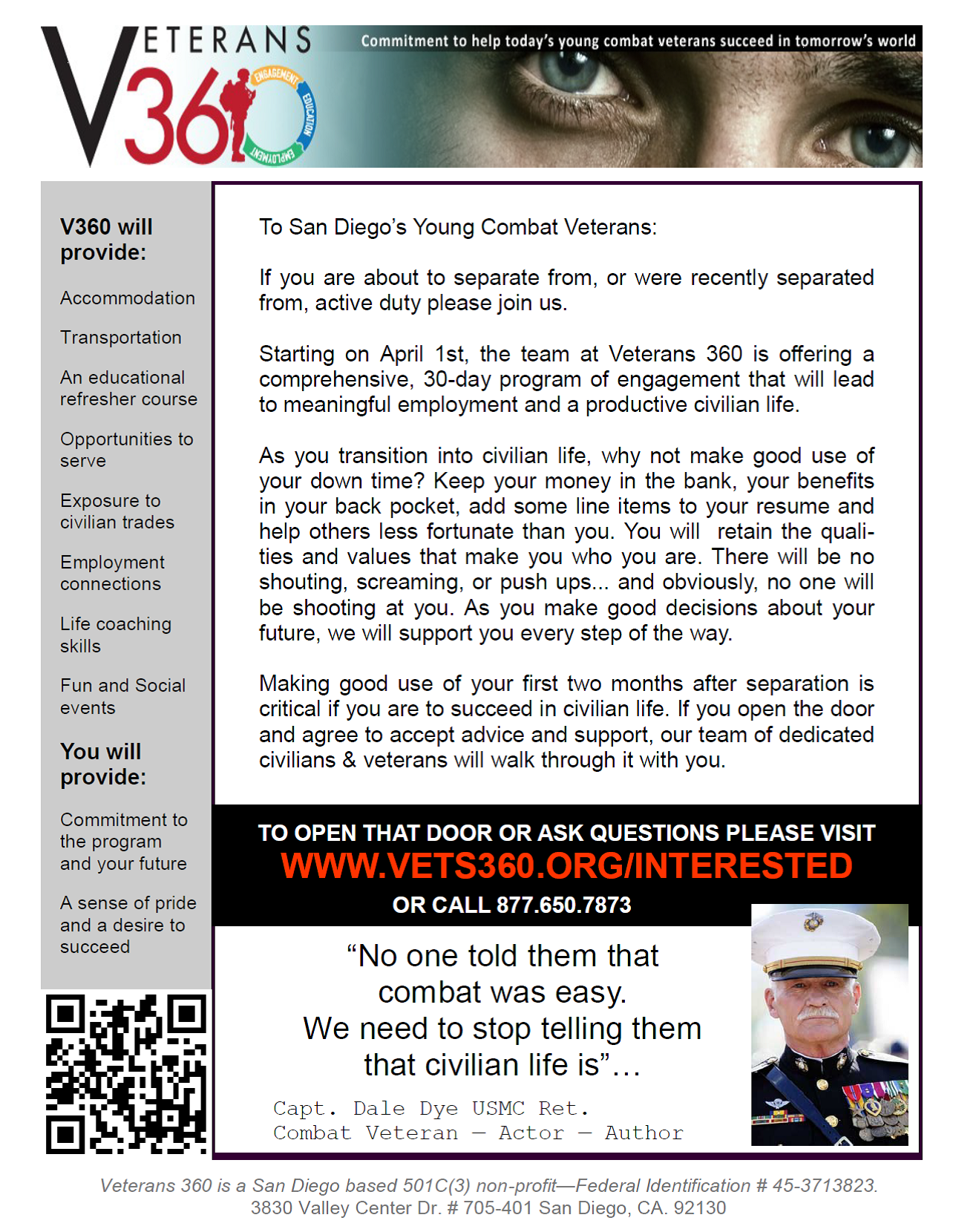
Veterans 360 is about to kick off their inaugural squad engagement on April 1st of this year.  They are looking for candidates to participate in the program.  The details of the initial effort are listed in their recruiting poster:

Veterans 360 Recruiting Poster

If you are a combat veteran in the San Diego area who is looking for something innovative to help with your transition, check it out!

The sound of no phones ringing as my VA saga continues

In my most recent post I lamented about the languishing status of my service connected disability claim.  It had been partially settled, but half of the conditions under review still required action and that action was very long in coming.  It is month seven and counting since I was informed that “I would be contacted” by a VA representative to continue the work on my claim.

At month five or so I called to see what was up.  After many failed attempts, I got up extra early and called when the call center opened, and after being on hold for a half hour I was able to speak to a representative.  Long story short, he initiated an official inquiry which included the promise that I would receive a telephone call from the regional office that was working my claim.  In ten working days or less.

Well, ten days came and went, so this morning I again got up extra early (well, not that extra early because I get up before 0500 anyhow) and I called the VA.  After navigating the automated menus I was informed that I would be on hold for 22 minutes, so I waited.  45 minutes later a voice broke the elevator-esque hold music monotony and asked how she could help.

I explained my dilemma, and she pulled my information up on her computer.  I heard the clattering of her typing on her keyboard along with a sigh.

“They did not call you?” she asked.

“Nope.”

“They marked it closed, but there are no notes that show a call was conducted…”

Great.

It turns out that my Official Inquiry had been marked closed with no action taken.  No call.  No notes.  No action on my claim.

I was a bit annoyed, and she was a bit perplexed.  I got the feeling that I was not the first person that she had spoken to with this problem.  To her credit, she calmly explained the next steps as she typed away.  She notified her local supervisor as well as the supervisor and the team that was supposed to contact me about the problem, and apologized for the whole incident.  She went so far as to say that whoever closed my inquiry had actually lied about it and not done their job.  She said that someone may call me to update me on the status of my claim, but she also wisely did not promise that anyone would actually pick up the phone.  Neato.

As for my claim, she further explained that the crux of the problem was that while my issues had been partially resolved (with a completed disability rating for half of my identified conditions) the remaining issues would be addressed in the future.  How far in the future she could not say.  Eight months was the average for the initial claim (which was close to my timeline), but there was no expected timeline for the rest of the issues.  It could be a day, a week, a month, a year, or more.  Neato again!

So there you have it.  My first call resulted in a promise of a call back that never came.  My second call resulted in a complaint that nobody called, and I don’t know if anyone ever will.  Time will pass, I suppose, and maybe my phone will ring.

I won’t hold my breath.

__________

Lessons Learned:

1.  Stay on top of the process!  If you are promised a phone call, follow up if you do not get it.

2.  Call early in the day and you will get through.  Eventually.   My experience is that your wait time is twice the amount of time announced, so get a cup of coffee or two and read the paper because it is going to take a while.

3.  Don’t get angry.  The person on the other end of the phone is a person too, and they had nothing to do with your particular issue.  If you make them angry they will not be helpful.  Remember the golden rule!  Be nice and help them help you.

Back to the Veterans Administration, Part 3: This is not the appointment you were looking for…

In my last blog entry I promised that I would update you on how my first official appointment with the VA went, and, well, that appointment has come and gone.  It was interesting, but not really what I had expected.  Or what I was hoping for.  It was, however, insightful because it provided a glimpse into the road that lay before me as a “customer” of the VA healthcare system as well as introducing me to many of my fellow veterans who frequent the local clinic.

The appointment was with the VA Clinic’s PTSD Services unit.  As I wrote in my last post, I spent an hour or so with my designated social worker whose job it is (among other things) to assess whether or not I needed to be evaluated for the effects of combat stress.  Her assessment was based on our meeting as well as the sixteen page questionnaire that I completed beforehand.  Since the questions were all about combat, and having spent a whole lot of time in and around a significant amount of combat in two different war zones, she determined that it was certainly appropriate for me to go for an evaluation.

A week later, I returned to the clinic for my first appointment: the Post-Traumatic Stress Disorder Services Orientation.  I wandered into the clinic’s Mental Health Services waiting room and, after checking in, was handed yet another set of forms to fill out.  After ten minutes of answering questions about my propensity for self-harm, manic episodes, and depression, I was finished.  Just in time, too, because as my government issued pen scratched out the last checkmark a young woman opened the waiting room door and asked those of us waiting for the PTSD orientation to follow her.

I joined a rather eclectic group as we accompanied her to a smallish room ringed with chairs padded with leather seats and backrests colored in the oddly disturbing green that is prevalent in hospitals and movies about psychiatric institutions.  They must have got them on sale somewhere, because I don’t think they would match anyone’s home decor.  To their credit, though, they were actually pretty comfortable.

Out of the twenty odd-colored seats ten or so were filled by my fellow attendees and me.  There was an elderly veteran of the Second World War, Korea, and Vietnam (as his hat proudly proclaimed), a man in his sixties, a few gentlemen in their 50’s, a young woman who never took off her sunglasses, a tattooed young man barely out of his teens, and me.  Not at all what I was expecting, to be honest.  I had figured that my meeting would be with young veterans from the recent decade of war, but to my surprise we veterans of Iraq and Afghanistan were in the minority.  There were three of us, one veteran of Desert Storm, the aforementioned WWII vet, and the rest were from the Vietnam War.

I know this because the young woman who led the session (another clinical social worker) had us introduce ourselves before we began the session.  In addition to asking where we served, she asked us to share why we were here.  The recently discharged veterans were pretty obvious, but the others were a surprise.  Each of them had been referred to the session by their primary care provider, which I found to be fascinating.  After hearing their introductions and listening to their conversations it became evident to me that many of these veterans were just now entering the VA medical system.  To me, that was a surprise because I had never really considered not entering the system.

That reveals a tremendous difference between the experiences that “new” veterans have in juxtaposition to the “old” ones.  Our transition process from active duty included a mandatory introduction to the VA, along with an education in the basics that the VA provides.  Many veterans of WWII, Korea, Vietnam, Desert Storm, and the Cold War received no such exposure to the Veterans Administration.  As a result, thousands and thousands of veterans who are eligible for help and care never bothered to pursue it until they really need the services that the VA provides.  Unfortunately, for many of them, the help that the VA provides ends up trying to make up for years or decades of neglected conditions.  That was the explanation for why so many of the people in the room with me were there for the first time despite having removed their uniforms back when Disco Fever ruled the dance floor.

Anyhow, back to the session.  After introductions, the social worker ran through a dozen or so power point slides that described the multitude of programs that the VA offered in the clinic.  This particular clinic was focused on combat veterans who were at risk for PTSD, and the services that they provide were all focused on countering and healing the effects of combat stress.  She started with textbook (according to the American Psychiatric Association, who writes such things) definition of PTSD, which included things like experiencing traumatic events, re-experiencing previous trauma, hyper-vigilance and hyper-arousal, and avoidance of things that remind you of traumatic events.  Considering that everyone in the room has served in combat, the probability that at least some of these symptoms would apply to us rocketed up to about 100%.

After the explanation of what PTSD was completed she assured that recovery from PTSD was possible.  They offered over a dozen different methods to assist with recovery; including individual and group sessions on topics like anger management, coping, spiritually based recovery, couples and family therapy, anxiety disorders, and women’s groups.  The goal of each program is to help the veteran reach a positive outcome within three months, with a positive outcome being that the veteran being better able to cope with his or her condition.

Not surprisingly the clinic was overwhelmed with veterans who needed help.  The wait time to join in the programs was eight weeks or more.  The social worker explained the process for getting into one of the groups, and that is where I realized that this was actually not the appointment I was looking for.  Actually it was not even really an appointment, but instead just an introduction and orientation to the clinic.

Towards the end of the session she explained that for us to participate in any of the offerings we would have to set up another appointment in which we would actually meet with a healthcare provider who would then assign us to a group.  An intake appointment, she called it.  That was the first indicator that this was not the appointment I was looking for.  The second indicator was her announcement that the clinic did not have anything to do with disability claims.

As you know from my previous posts, I was actually hoping to get my disability claim back on track.  It had been five months since I had been notified that the claim had been partially settled and that I should wait to be contacted by the VA for further evaluation.  After spending almost half a year listening to the sound of no telephones ringing I called the VA to get the ball rolling.  I had wrongly assumed that once I was in the system that the claims process would proceed as a matter of course.

Nope.

I would need to call another number for that, or I could stop by the Veterans Service Office that happened to be just across the hall.  They would be able to help those of us working on our claims, she said, but unfortunately not today because their office was closed.

D’oh.

She then reviewed all of the forms that we completed prior to the session, and then she called each of us out individually to set up appointments for the intake interview.  I was a bit disgruntled, but resigned myself to just go with the flow and left the session with an appointment for an intake appointment some six weeks in the future and the phone number to the clinic’s VSO office which would help me with my claim.

I also left reminding myself that the VA was a bureaucracy and that patience was a virtue.  I was still disgruntled, though, and not feeling particularly virtuous.  So it goes.

__________

Lessons Learned:

1.  The medical side of the VA is different from the disability claims side of the VA.  Make sure to stay engaged with your VSO to ensure that your claim is moving forward, and also be specific with the VA representatives when you are making your appointments.  I was not specific enough because I made some errant assumptions, and as a result I have lost another month or two of forward progress on my claim.

2.  Be ready to devote a lot of time to the VA.  There are great programs available, but it will take a long time and plenty of seemingly repetitive red tape, paperwork, and meetings to actually see a provider.  Breathe deep, think happy thoughts, and go to your happy place.  Time will pass and you will get the help you need.  It will just take a lot more time than you would like.

3.  Ask questions up front.  Had I asked whether or not this appointment would help with my disability claim I would have saved some valuable time.  Assume nothing!

Back to the Veterans Administration, part 2: Entering the system

I left you, my dear readers, hanging with my last post.  When we last connected I was about to go to my first live and in-person post-retirement Veterans Administration engagement.  After months of waiting for a call that never came I shouldered the responsibility for my own situation and, after more than a few phone calls, set up an appointment to become a customer of the VA.

The instructions were simple enough.  I was directed to arrive at the local VA clinic at ten in the morning, and upon my arrival I would be meeting up with the Benefits and Enrollment specialist.

So arrive I did, right on time.  I walked into the lobby of the recently built and still sparkly building and sauntered up to the reception desk.  To my chagrin, there was no one at the desk, so I rather aimlessly just leaned on the counter until somebody arrived.  There were two chairs behind the desk after all, and they looked recently abandoned.

After a few minutes of pointless leaning I decided to find someone who could help me.  I wandered past the reception desk and into the halls beyond.  After walking from one side of the building to the other in hopes of randomly finding the office I was looking for I gave in and asked an employee (whom was readily identifiable by her hospital scrubs and prominently displayed VA Identification badge) for help.

“Go to the lobby and check in with the girl up front,” said she.

After explaining the absence of said girl, the employee shrugged and pointed back the way I came.  “Just go back to the lobby. Someone will call for you.”

I was not particularly optimistic that said calling would occur, but I meekly headed back to the lobby anyway.  Joining a few other patient souls in the chairs that ringed the perimeter of the room, I found a copy of Time Magazine from the previous year to fill my time as I waited for the call that I was not certain would come.

After ten minutes of reading about Time Magazine’s view of the world circa October 2011, a door that previously gone unnoticed burst open.  An energetic gentleman with short graying hair and an startlingly positive outlook on life fairly leapt onto the scene and immediately started asking each of us in the lobby why we were there.

After a staccato interchange between the people sitting next to me, he turned in my direction and asked if he could help me.  I explained that I was there to meet with the enrollment section.  He smiled and said “That’s ME!” and pointed me towards the still-open door and one of the vacant offices on the other side.  “Take a seat, I’ll be right there.”

So in I went, clutching my sheaf of medical records and other documents, wary to see what would happen next.

John, as I learned his name to be, had obviously introduced a few people to the VA system before I showed up.  Probably thousands of people.  He had it down!  He handed me a sixteen page long questionnaire to fill out and began firing questions at me faster than a belt fed machine gun.

“Retired?”  “Yep.

“How long were you in?”  “Twenty seven years.”

“Social?”  (As in what was my social security number, which is the key that opens my files in pretty much every government database).  I gave him my precious nine digits.

“Marine?”  “Yep.”

“What did you do in the Marines?”  “Where do you live?”  “Do you have TRICARE?”

Each question was accompanied by his furious banging on the computer keyboard as he entered my information into the computer.  I was trying to complete the form as he talked, which he noticed.

“Don’t worry about that right now.  That is for the social worker, who I will introduce you to in a few minutes.”

Social worker?  Really?  What was that all about?

“For now, let’s just get you in the system…”and from there we were off on a journey of questions and answers that lasted ten or fifteen minutes.  I won’t subject you to the lengthy details, but here is a rundown of the pertinent ones for those of you who will be headed to the VA:

– The difference between TRICARE and the VA.  He patiently explained that TRICARE is insurance, and the VA provides traditional medical care, just like your regular family physician.  While that statement sounds obvious, the ramifications are significant.   If you are injured in an accident or have an emergency away from your normal VA provider, TRICARE takes care of it because that is what insurance is for.  The VA is not insurance, so you would be in trouble when the bills came due for emergency treatment because the VA does not pay for such events because the VA is not insurance.  Kapisch?

– Online enrollment.  I had previously enrolled into the VA healthcare system because they had thoughtfully sent me an email several months ago.  The email, which suspiciously looked like spam (but wasn’t) encouraged me to register via the VA website by following this link: https://www.1010ez.med.va.gov/sec/vha/1010ez/  I filled out the form, and I am glad that I did because it reduced the amount of time I spent with with the enrollment specialist by at least half.

– The Packet.  The sixteen page packet that he handed me was the OIF/OEF/OND (Operation Iraqi Freedom, Operation Enduring Freedom, and Operation New Dawn) enrollment questionnaire.  In a nutshell, it was a long questionnaire that asked a lot of questions about my mental health, combat experiences, and exposure to traumatic brain injury (TBI).  The form would be used by my social worker.  More on that later.

– Explanation of how the clinic works.  This particular clinic is divided into three teams (Red, White, and Blue…pretty catchy!) and each team had a staff of its own.  In my case I became a member of Team White, and with my assignment came my choice of primary healthcare providers.  Since I did not know any of the doctors personally, I happily chose the one with the next available appointment time (which happened to be a month away).

– My first appointment with the doctor would be a “welcome aboard” type of physical examination, and I would be required to visit the lab and submit various bodily fluids beforehand.  Joy.

– Appointments.  In order to set up an appointment, I would not be allowed to call the doctor or the clinic directly.  I must call central appointments (via a 1-800 number) in order to contact someone at the clinic.  That is pretty much the same as life in uniform, so it wasn’t a shock, but it is annoying.  If I want to ask the doctor about a medication, for example, I need to call central appointments and leave a message for him.  Then, when he gets the message and has the time, he is supposed to call back.  I hope I don’t have any time critical severe allergic reactions!

-ID Card.  Towards the end of the interview he announced that it was time for me to get my VA ID.  I sat up straight and looked at the camera that was mounted above his computer screen, and when he said smile I did so.  In a week or two my card should show up in the mail, and then I will know just how stupid I look.  No second chance for a new picture!

As soon as John was done with me he guided me to another office and introduced me to a very nice woman who would be my social worker.  She asked if I had completed my form, and as I had not she gestured for me to take a seat and fill it out.

I did so, and after ten minutes of scribbling I knocked on her door.  She invited me in, and after taking the sheaf of papers from my clutches she began her own interview.

Now, you should understand that this is probably the first time in my life that I have ever been in a room with a social worker.  I have met people in that line of work in the past, but never have I actually been professionally engaged by one.  Honestly, I had no idea what social workers actually did, but after spending a half hour with a pro I was pleasantly surprised to learn that they fit a niche that is needed in the VA: helping veterans who are having difficulty transitioning back to the civilian world deal with the often confusing processes that come with  the title “veteran”, not to mention little things like PTSD, TBI, and other psychological issues.

At any rate, she had the unenviable task of manually inputting the responses I scribbled on my questionnaire into the computer database.  Obviously some parts of the VA could use a little modernization, but she explained that she actually got more out of re-inputting the data because she could interact with the client (me, in this case) and flesh out her perspective on the information.  This is important because she was evaluating things with real impacts on veterans, such as combat stress problems and indicators of violence, self harm, and suicide.  She was there to make sure that we, the combat veterans, were looked at objectively and offered the appropriate levels of care.

After an hour or so spent chatting with the social worker, she led me to the appointment desk at the combat stress clinic.  The results of my survey indicated that meeting with them would be a good idea, and to be honest I believe it is a place that all combat veterans need to visit.  The wars of the last decade have seen an unprecedented  level of stress on the military forces, with many veterans deploying to war time and again, and then again, and again.  The frantic deployment tempo means that many veterans bring issues and problems home, and the VA is there to help deal with them.  Going to the clinic is the first step along the way to getting better, and whether you think you need it or not you should stop by.

So now I am officially in the VA system, and I have several appointments in the future that I will tell you all about.  Stay tuned!

___________

Lessons Learned:

1.  After your claim settled, either partially or in full, you should be receiving an email inviting you to enroll in the VA via their website.  Initially I thought the email was spam, but after several attempts I finally paid attention and registered.  Doing so greatly streamlined my in-person registration process.  As an aside, they used the email address that I provided months earlier as I was transitioning out, so it behooves you to make sure that you provide an address that you will utilize for a long time to come.

2.  The VA is just like every other government bureaucracy.  Get ready to do some things twice, and if your are lucky, three times or more.  It is just the way it is.  Suck it up and march on.

3.  It will help for you to bring whatever documentation from the VA you have accumulated thus far.  I recommend that you buy a pocket folder or folio to keep everything in.  Even better, get yourself a dedicated filing system for all of the stuff that you are amassing because if you don’t you will end up with a disorganized pile of documents approaching the stature of the Eiffel tower.  If you don’t believe me, just look at the pile next to my desk at home.


Back to the Veterans Administration

Several months ago I received a rather large package from the Veterans Administration.  Inside was the copy of my medical record that I had submitted with my claim some nine months earlier as well as a sheaf of rather official looking documents.

Hooray, thought I!  My claim was settled.

Well, kind of.  Actually about half of my claim was settled, and the other half was not.

You see, as I departed active duty I was thoroughly examined by both military and veterans administration physicians as a part of the final physical process.  The Navy doctors and corpsmen checked me out and documented everything that was relevant into my records, and the VA then followed up with an examination of their own to determine what conditions, if any, that I had developed during my service would be considered disabling.  Having the conditions rated as disabling is important because the VA treats those conditions free of charge.

In my case, about half of the conditions that had been identified during my physicals were rated as disability-related conditions and would be addressed by the VA in the future.  The other half were marked as “deferred” because they needed additional information.  The letter went on to say that they had requested a medical examination, and that I would be “notified of the date, time, and place to report.”  It sounded reasonable, so all I had to do was be patient and wait.

One month went by.

Then two.  Then three.  Four.  Finally at month five I decided that my phone wasn’t going to ring any time soon and I needed to do something about it.  But what?

Thinking back to my experience at the Transition Assistance Course I remembered that a representative from the Disabled American Veterans had talked me through the VA medical evaluation process as he evaluated my medical record.  I had signed a limited power of attorney that appointed the DAV as the Veterans Service Organization that would represent me in my VA proceedings, and now it was time to give them a ring and ask for some help.

After rummaging through the rather tall pile of transition related documents that occupies a significant portion of my desk I found his business card.  “Aha!”  thought I.  “A call and it will all be fixed!”

Wrong again.

I did call the number, only to find that I was calling the wrong number.  It turns out that the gentleman that I had worked with during the TAP seminar was not the same gentleman that I would be working with in my dealings with the VA.  The guy at TAPS was fully engaged in meeting new veterans and helping get their claims processes started.  Once the veterans were in the DAV system they (including me!) would be working with representatives at their regional office located in San Diego.

So I called that number.  Unfortunately their offices were closed for the holidays, so I called back once the holidays were over.  I finally linked up with a live person and after speaking to a very nice lady who took down some basic information were instructed to wait for a representative to call me back.

After a day or two of swapping voicemails because of missed calls the DAV representative and I finally linked up on the phone.  I explained my dilemma to him, and he patiently explained what needed to happen next.

“What you have,” he said,” is a partially completed claim.  At this point there really isn’t anything the DAV can do for you because our process begins when the initial VA claim is settled.”

Sensing my frustration, he continued.

“What you need to do is to contact the VA and set up an appointment to get the ball rolling yourself.  You need to do this quickly because if you don’t follow up on the listed conditions they may be disallowed because you are not showing that they are still a problem.”  He then gave me the appropriate phone number for the closest VA office and we said our goodbyes.

Hmm… So I need to get my sore knees and bad back looked at again?  I had signed up for TRICARE Prime, so I could go to the doctor, but my decades of “sucking it up” had precluded me from making an appointment for something that did not involve broken bones or arterial bleeding.

So I called the VA the next day.  After a similar game of telephone and voicemail tag I spoke with a very helpful gentleman who understood exactly what my dilemma was.  He checked his calendar and squeezed me into an appointment this coming Wednesday, where he promised to get my ship sailing in the right direction.

And I promise to tell you how it goes…

__________

Lessons Learned:

1.  Contact your VSO immediately after you receive your VA claim settlement letter.  I lost about five months as I waited for the VA to contact me before I finally got on the ball and started engaging the system.

2.  The VA is buried in claims and the best thing to do is to take charge of your case.  Waiting just means that others who are being proactive are jumping in line ahead of you.

3.  Your VSO can explain the intricacies of the settlement letter in a phone call, but you have to contact them to initiate the conversation.

4.  The next call you make after the VSO should be your local VA office in order to initiate the next steps in the evaluation process.  If your claim is settled, then you need to contact them to be registered in their computer system so that you can access healthcare providers.  If your claim is not fully settled, then you need to get registered and schedule appointments with the appropriate professionals in order to finish up your claim.

Interviewing, part 3: Curveballs and questionable questions

The purpose of a job interview is to determine whether or not you are suitable to join a company’s team.  How the interviewer figures that out, however, can be unusual, uncomfortable, and sometimes downright odd.  It can also be illegal.  You need to be prepared for when the interview goes in an unexpected direction.

You expect to be asked about your experience, skills, education, and training during a job interview.  You may not be expecting some of the tools that companies use in their hiring process to find the best candidates for the job,  though.  Some companies will ask you to take a personality test (to see what you are really like), submit a handwriting sample (to be analyzed by handwriting experts), have your picture taken (so that others who are involved in the hiring process can see what you look like),  or something equally strange.  These questions and tests are perfectly legal, even if they seem a bit unusual.

What about questions that are not legal?

There are some questions that are not permitted, by law, to be asked of an applicant.  Although they vary from state to state, they generally fall somewhere in the following list:

  • Age
  • Gender, sex, or sexual preference
  • Race, ethnicity, or heritage
  • Disability
  • Faith or religious beliefs
  • Marital status
  • Pregnancy or children

There are a few more for serving military veterans:

  • Classification of discharge
  • Military related disability status (particularly PTSD)
  • Post-military benefits status (healthcare, pension, etc.)
  • Whether you are in the National Guard and Reserves

Professional interviewers are well aware of which questions are permitted and which are not.  Not all interviews are conducted by professional hiring managers, though.  Many are conducted by small business owners, retail store managers, restaurant chefs, or anyone in business who needs to staff a position in their organization.  These interviewers may ask a question that they shouldn’t without realizing it, but even though they don’t know the law they are still required to follow it.

There is another possibility, too.  The person conducting the interview may be asking you questions that they know are illegal but they ask them anyway.

Regardless of the circumstance, when one of these questions is laid on the table it is up to you to figure out what to do about it.  You have about a millisecond to decide whether you will answer it or not.  How much do you want the job?  That it what it all boils down to in the end.  If you stonewall, refuse to answer, or debate the legality of the question with the interviewer the probability of you landing the job will rapidly approach zero.  However, if you feel that the interviewer is crossing the line intentionally, then perhaps the company is not really a place where you would like to work anyway.

You have to ask yourself the simple question: “Is answering that question worth getting a job with this company?”  If you answer yes, then do as you are asked.  If not, then don’t.  It is a simple as that.  The downside is that you are certainly guaranteeing that you won’t get the job.  Do you have to answer an illegal question or fulfill an odd request?

Nope.  You can say no.  And probably not get the job.  It is up for you to decide.

__________

Lessons Learned:

– Not everyone conducting an interview is a professional.  They may ask questions that they shouldn’t out of ignorance.

– There are illegal questions, unusual questions, and uncomfortable questions.  Regardless of where those questions lie on the spectrum, it is up to you as to whether or not to answer them.

– There are some questions that pertain specifically to serving military and veterans.  Your military and VA benefits are personal in nature, as is any pension of disability payment that you receive.  Disclosing any of that information is up to you, should any such questions come up.

– It all boils down to how much you want to work at the company.  Questions may be asked innocuously, and making a big deal out of it will likely cost you a job offer.

Not so traditional job interviews, part 2: Lunch, Dinner, and Cocktails

There are many kinds of interviews, and we have covered quite a few of them thus far.  Today we are going to take a trip to your hiring manager’s favorite restaurant or bar and learn about just how similar interviewing for a job is with a drink or a cheeseburger in your hand is to a traditional interview.

Just how similar is it, you ask?

It is a little similar.  And it is completely, totally, and utterly different at the same time.

It is similar to all interviews in that the goal of the interview never changes: the company wants to fill a staffing need and you want to find a job.

That’s about where the similarity ends.  The devil is in the details, and there are a lot of details to an interview in a bar or a restaurant.  Trust me.

Why would a company want to conduct an interview outside the office?  There are a lot of reasons, but we’ll drill down into four significant ones:

  • First, you may not be able to get your schedules to align during working hours, and the hiring manager may simply find it easier to interview you outside the normal workday.
  • Second, it may be a small company.  Small companies often don’t have hiring managers, or may not even have managers at all.  Small business owners may be busy running their businesses during normal hours and the only way they can squeeze interviews in is to meet with you for a meal or a drink.
  • Third, the company may still be feeling you out.  The interviewing process is often a lengthy one that may begin with a phone call that is followed by a lunch meeting and then, if things go well, a more formal interview at the firm.
  • Fourth, the company may be seeing what kind of person you are outside the formal interviewing arena.  They want to observe your manners, your social awareness, etiquette, etcetera.  This is particularly the case for positions that place the employee in the public’s view, because the firm doesn’t want to hire a caveman to represent them in the business world.  It is also an opportunity for the company to evaluate how well you will fit into their culture by observing you in a social environment.

Regardless of the circumstance under which you find yourself in this type of interview, the most important thing to remember is that you are being observed, evaluated, and judged from the second you meet up to the second that you leave.  Don’t forget it!

The best way to proceed with an interview at a restaurant is to treat it like a date.  You don’t want to look like an idiot in front of a prospective significant other, and you certainly don’t want to look like an idiot in front of a potential employer.  This type of interview is one where you can really make a knockout impression or have the opposite effect of making the person across the table run screaming out the door.

The choice is yours.

The basics in dating apply to lunch or dinner with a hiring manager.  Dress nicely, just as you would for an interview, show up a few minutes early, and double check yourself in your car’s rearview mirror before you get out of the car.  It is always embarrassing to find out after it is all over that your necktie was crooked or that your was hair is sticking up like Don King’s.

You should also do a little homework about the restaurant before you go.  Look at their menu online, and decide what you would like ahead of time.  The hiring manager probably uses the restaurant routinely and knows exactly what to order and it will be awkward for you if you are stumped by what to order when the waiter shows up.  I recommend that you order a salad because it is easy to eat with a knife and fork (not your hands!) and will not put you in the awkward position of trying to eat the world’s greasiest cheeseburger without making a mess out of yourself in front of your interviewer.

That brings me to a significant point about military people, food, and table manners.  Most military folks view consuming food as a method of calorie loading: we need to feed the machine to keep the machine going.  We eat too fast, talk while we eat, and generally just shovel it in, starting on one side of the plate and stopping when we run out of food on the other side.  Not only is this not a way to impress a date, it is certainly not a way to impress an interviewer.

Remember your manners: be polite to everyone (including your server!), use the proper utensils (don’t eat everything with your spoon because of years and years of experience eating rations with the issued plastic spoon), and SLOW DOWN!  A good rule of thumb is to take a bite, chew it at least ten times, swallow, and then take another bite.  Take small bites and pace how quickly you eat your meal with the interviewer.  You will be talking through the meal, and it is quite embarrassing to try to answer a question right after you shove half of a steak into your gaping maw.  To help with this, try paying attention to yourself the next time you eat alone — I’ll bet you will be surprised at how much the military lifestyle has affected your table manners as you mow down French fries like a belt fed machine gun.

Treat your interviewer with the same deference and respect as you would a date.  Allow them to be seated first, and follow their lead in ordering.  Avoid alcohol and drink sparkling water or iced tea.  Remember, you are being evaluated through the entire process, and if they sense that you are a three martini lunch kind of person then you will likely find yourself pursuing an interview with another company.

Place your napkin in your lap and keep your elbows off the table.  As with a date, it is a good idea to have some topics of conversation ready.  Lunch and dinner interviews tend to be a bit more informal and social, and the hiring manager is feeling you out to see if you are a social match with the company in addition to asking about your skills.  Remember the rules of the military mess: do not discuss politics, religion, or sex. Any one of those topics will be a guaranteed job loser.  Even if the interviewer initiates a conversation on one of those topics do your absolute best to steer the discussion back to the company and your interest in working there.  One thing that may help is reading the newspaper before you go to the interview or listening to the news on the radio in order to have something to chat about when you need to fill some time.

Here are a couple of other do’s and don’ts:  don’t complain about the food (do you want to look like a whiner?), don’t get a to-go box for your uneaten food (you will look cheap), don’t order dessert unless the interviewer does, and lastly do be both appreciative and gracious when he or she picks up the tab.  It is assumed that the company is paying the bill, but it is good form to be thankful for the free lunch or dinner that you just enjoyed.

So there are some tips for an interview over a meal, but what about an interview in a bar or lounge?  That is again similar, but also different.

Think of being interviewed in a bar as the same as running through a minefield in your underwear — it can be both embarrassing and potentially lethal for your career.  You can do just fine, however, if you treat it as an interview the entire time you are in the bar.  My recommendation is to order one drink and nurse it all night.  The best drink to order is a Gin and Tonic because you can just keep topping it off with tonic or soda water and nobody will ever know.  Keep the conversation clean and on topic, and even if the interviewer gets hammered don’t give into temptation to join him down the boozy trail!

You may be interviewed in a bar for the same reasons as you would be for a meal, but now you have the added factor of involving alcohol.  This is a big deal because we all act differently after a few shots of loudmouth juice.  Here how an interview at a bar can change everything:

A prospective employee spends an afternoon interviewing with a company.  He meets people at varying levels of the company and impresses them all with his savvy demeanor and job skills.  So much so, he thinks, that they invite him out for drinks after work.

While having a few cocktails he shifts out of “jobseeker” mode and back into “military” mode, complete with a liberal sprinkling of the “F” bomb and barracks humor.  He had a great time, but was very surprised when he was informed that he would not be working at the company.

The trip to the bar was part of the interview.  They wanted to see what the interviewee was like outside the office, and they learned enough to know that he was not someone that they wanted in their firm.  He blew his shot because he was not savvy enough to see that rule number one of interviewing is that the interview is not over until you start working at the company or they tell you to go away.

Now that is a lesson worth learning.

__________

Lessons Learned:

1.  You are being evaluated the entire time that you are being interviewed, from the moment you walk into the restaurant until the moment you leave.  There are many more things to get wrong in this environment, so limit your possible mistakes by preparing before you go.  Check the restaurant location and menu online before you leave home.

2.  Be ready for some chitchat, but stay away from politics, religion, and sex.

3.  Be polite to everyone.  The interviewer will notice if you are a jerk to the waiter and you will NOT get a job offer.  I guarantee it.

4.  Eat a salad.  Avoid the Monster Burger.

5.  Manners, manners, manners!  Slow down.  Bite, chew, swallow, repeat.  Don’t shovel in your chow like it is the last MRE you will ever eat.

6.  Be gracious and don’t forget to mention how much you enjoyed lunch or dinner in your thank-you note.

7.  If alcohol is involved, order one drink and nurse it.  Keep the barracks language and humor at the barracks.  It has no place in the business world.

The “traditional” job interview, Part 2: Into the Fire

Hello again!

I left you hanging on the edge of your seat in my last post, and today we are going to finish the traditional job interview story.  We left off with you at the coffee shop making your last minute preparations to cross the street and meet with the interviewer.  So go ahead and finish that donut, wash your hands, check yourself in the mirror to make sure that you don’t have crumbs on your shirt.  Let’s go meet the person who will decide your employment fate!

First off, you need to remember that you are most likely being evaluated the second your hand touches the company’s doorknob.  Maybe even before then, depending on the circumstances of your interview.  Here is a real example of how one company evaluates its candidates:

The firm pays to fly candidates out to their headquarters for personal interviews.  It is a thoughtful company that sends a van with a company driver to meet you at the airport and bring you right up to the company’s front door.  She shows you in, and you are directed over to a receptionist who points you to the floor and room where the interview will be conducted.  After a quick trip on the elevator, you meet another receptionist who confirms you are in the right place and notifies the hiring manager that you are there for the interview.  After a few minutes (and right on time) the hiring manger arrives and you head off to the office for the interview.

If you are not paying attention, you would offhandedly think that your interview started when the hiring manager shook your hand.  You would be wrong – dead wrong.  A part of the company’s hiring process is to see what kind of person you are; how you interact with people like van drivers and receptionists.  The hiring manager will certainly go through the interview process with you, but your performance across the desk from the interviewer is only part of the hiring procedure.

The van driver and the receptionists are asked by the interviewer what kind of person you are.  Are you rude to people you consider beneath your level?  Were you polite?  Did you shake hands?  Were you talking on your mobile phone in the van, and if so, was anything you said indicative of a reason not to hire you?  Did you treat the receptionist professionally?  Nicely?  Would they want you to be somebody that they would work with?

This company is not alone in assessing employment candidates on more than their skills and experience.  Culture and manners matters.  Remember that.  This is particularly important to senior military officers and enlisted people who are transitioning.  When you are a Colonel or a Sergeant Major you are in a position of elevated prestige and responsibility that can make you forget that the people at the bottom of the ladder are people too.  This is not an indictment of senior military people (after all, I used to be one), but it is the way the martial game is played.  As a senior leader it is easy to focus on your peers and immediate seniors and juniors because that is how you do your job and accomplish your mission.  Senior leaders are often so focused on their level that they don’t really see the people many levels below them.

If you treat people at the company like junior subordinates on your way to the job interview it won’t go well.  That way of thinking is archaic in the corporate sector, and you had best be conscious of it or it will severely limit your ability to find a job.

Anyhow, back to the interviewing process.  You walk through the door and meet the receptionist.  Be professional, polite, and shake his or her hand. This is your chance to make a positive first impression.  You don’t need to be artificial or insincere, but just be polite.  A smile goes a long way, too.

From there you are off to meet the hiring manager.  This is where you get a chance to make a second first impression, but this time with the hiring manager instead of the receptionist.  Go in, take the seat that they offer, and get ready to prove why you are the right guy or gal for the job.

Here are a few pointers for those first critical moments of the job interview:

1.  Have a firm, but not crushing, handshake.

2.  Look the interviewer in the eye, and thank them immediately for the opportunity to meet with him or her.  Practice this!!  In your rehearsal make sure to go over what you are going to say when you meet the interviewer so that you don’t get tongue tied.  Something as simple as: “Hi.  I’m Mike, and I want to thank you for the opportunity to meet with you today.”

3.  Don’t come in carrying a bunch of stuff, and turn your mobile phone completely off!  You should have your right hand free to shake the interviewer’s hand, and your left hand should be carrying either a briefcase (which is overkill unless you were asked to bring something along that requires a briefcase) or a nice looking notebook (not a high school spiral notebook or pad of sticky notes, but a folio or pad and paper set that is professional, conservative, and not tattered).  Make sure to have a nice pen – something that looks professional and does not have “SKILCRAFT US GOVERNMENT” stamped on the side.

4.  Focus your attention on the interviewer.  Don’t look around the office like a visitor at a museum.  You are there to get a job, not admire the books on the shelf.

5.  Sit down on the front half of the chair, fold your hands into your lap, and smile.  Don’t kick back, cross your legs, and drape your arms over the chair.  As the interview unfolds you can relax a bit, but if your mannerisms indicate you are a slacker then it does not matter how well you dress- you will be regarded as a well-dressed and unhired slacker.

So now the first few moments are over.  The interviewer is evaluation you on everything you do and say, so keep that in mind.  Don’t bite your fingernails, or pick your nose, or check your phone.  Sit upright, look at the interviewer, and answer his or her questions.

Think of the interview questions as opportunities for you to show why you are qualified and how well you can express yourself.  Don’t turn a question into a monologue by rambling on for five or ten minutes.  In your rehearsal you should focus on answering each question in a period of thirty seconds to two minutes.  Any longer than that and you will likely start to bore the interviewer.  Besides, you probably can’t say anything in ten minutes that you can’t articulate in two.

Don’t try to answer them exactly as you did in your rehearsal, but instead listen closely to the question, take a breath, and then answer it as straightforwardly and honestly as you can.  Leave your military jargon and barracks language at home – nobody, and I mean nobody, in the corporate sector is impressed by the liberal use of the “F”-bomb in an interview.

Also, it is not an interrogation, so it is ok for you to ask a few questions as well.  Just make sure that they aren’t stupid (like “how much will I make?” or “what is the vacation and sick day policy at the company?”).

Make sure to answer the questions that the interviewer asks.  Don’t try to steer the conversation in a different direction, but instead provide the answers that interviewer is looking for.  No BS, either!  If you don’t know an answer or are unsure of what the question is actually asking, be honest and say you don’t know or need the question to be rephrased.  The hiring manager has interviewed countless people before you, and your probability of fooling them with a BS response is about zero.  Plus it will show that you are not the type of person that they want to hire.

During the interview you may be asked if you would like something to drink.  Always ask for water.  That way you won’t have any hot coffee to spill on yourself or carbonation from a soda making you want to burp at exactly the wrong moment.

Be prepared for signals that the interview is wrapping up.  The interviewer may be up front and say that your time is up, or may begin saying things like “Do you have any last questions?”.  When the interview is over, it is over.  Don’t try to push the issue with stupid questions like “what are my chances to be hired?” or “how soon will you let me know your decision?” as they put the interviewer on the spot.  He or she will let you know how you will be contacted – let them lead with the information.  Don’t be needy and try to wheedle it out of them ahead of time.

When it is time to go, stand up, pick up your notebook, and shake the interviewer’s hand.  Thank them again for the opportunity to meet with them, and follow their lead from there.  They may escort you to the receptionist or all the way to the exit.  Feel free to make some small talk on the way out, but do not forget that the interview is not over until you are sitting in your car!  Many jobs have been lost because the interviewee blows it on the way out of the building by doing something stupid (like being rude to a receptionist, throwing the “F”-bomb around, or picking their nose in the hallway).

The last step in the interview is to write and send a thank you note to the interviewer.  No kidding.  A thank you note.  This will show your sincerity as well as cement your desire to work at the company.  Many hiring managers will not hire a person who neglects to send a thank you note.  It is an expectation and an essential element of business correspondence.  If you don’t have any thank you notes at home, stop by a stationery store and pick some up, or even better, have personalized notecards made.  It is a nice touch.

__________

Lessons learned:

1.  The interview is your opportunity to present yourself in the best light possible – dress well, be well groomed, be polite, and use professional language.  Not doing any one of the above will likely result in you not getting a job.

2.  Be respectful and polite to every person you meet.  You should assume that they are part of the hiring team at the company, and if you are rude to the receptionist the word will get out.

3.  The first moments of an interview are critical- don’t blow a shot at a great first impression.  Be on time, well dressed, polite, and turn off your phone!

4.  Answer the questions you are asked- don’t try to BS the interviewer.  Also, answer in a period of thirty seconds to two minutes.  No monologues.

5.  If a drink is offered, make it water.  Coffee, tea, or soda may be more tasty, but you are not there to get  refreshments.  You are there to get a job, and the possibility of disaster through spilled coffee or an errant soda-caused burp are not worth it.